

Anno 117: Pax Romana: Although it isn’t particularly welcoming to new players, Anno 117: Pax Romana is not only one of the most beautiful city builders I’ve ever played, but also an incredibly rewarding experience. – NikolaOtasevic
I’ve been playing city builders since childhood, dating all the way back to SimCity on the Super Nintendo — although, admittedly, I had absolutely no idea what I was doing back then. Lately, I’ve completely fallen in love with ancient city-building games like Citadelum and Thrive: Heavy Lies The Crown. After spending a lot of time with games in this genre, I honestly think Anno 117: Pax Romana might genuinely deserve the title of king of city builders.
Anno 117: Pax Romana Campaign or Sandbox – Where to Start?
When you first launch the game, Anno 117: Pax Romana offers multiple ways to experience it. You can choose between sandbox mode or the campaign, and for a first playthrough I would strongly recommend starting with the campaign. You play as either Marcia or Marcus, brother and sister, children of Emperor Decimus. This is the first time the series allows you to play the campaign as a woman, which I immediately chose. It was genuinely interesting seeing a game set in Ancient Rome through the perspective of a female ruler. Naturally, a large part of the story revolves around her husband and the fact that she essentially has to rule in secrecy, but I still appreciated having that option.
While I was busy building my city, the story constantly pulled me into surprisingly dramatic moments. At times, it honestly felt like watching a historical soap opera. Yet the more I played, the more invested I became in the characters — and considering they’re mostly just floating heads with voice acting, I genuinely have to praise Ubisoft for making me care about them.
Albion and Latium Feel Like Two Different Games
At first, the campaign in Anno 117: Pax Romana felt very slow, so I actually learned more through sandbox mode. However, as I progressed further into the campaign, I began understanding how the game’s mechanics truly affect your city, whereas in sandbox I often felt like I was simply guessing. I could expand faster and further there, but I still didn’t fully understand how everything connected together.
For example, in sandbox mode you can choose between Albion or Latium, and during the campaign you’ll eventually play in both regions. They feel dramatically different from one another. Not only do they look visually distinct, but they also feature entirely different types of citizens, meaning their needs — food, clothing, entertainment — all differ as well. Even though the core systems remain the same, it honestly feels like two separate games.
Albion also introduces environmental challenges, and as you progress through research trees, you gradually unlock ways to deal with those problems. When entering Albion as a Roman ruler, you’re faced with major decisions: do you impose Roman traditions onto the Celtic population, or do you embrace and merge both cultures? I started with the Waders, but once I upgraded my population, I was given the option between Romanized or Celtic citizens. That decision also changes how other leaders perceive you, which can complicate diplomacy significantly.
War Is My Least Favorite Part
In games like this, I usually try to keep everyone happy because I avoid war whenever possible. But Anno 117 genuinely forces you into decisions where somebody will dislike you, and that creates some very interesting tension.
As I already mentioned, wars can happen later in the game — and honestly, that’s by far my least favorite part of Anno 117: Pax Romana. Not because the combat itself is poorly designed, but because I generally dislike warfare in city builders altogether. I would much rather deal with internal politics or natural disasters than naval warfare. Sailing across the sea to fight battles simply isn’t my idea of fun, and I honestly wish this aspect felt more optional.
Still, Ubisoft implemented plenty of automation systems that help players like me manage combat more easily. Technically, you should be able to negotiate peace with most factions, but I completely stalled in the campaign once Voada declared war on me. The game never properly explains how to achieve peace outside of throwing money at the problem.
Learning the Systems One Mistake at a Time
At that point, I had only just begun understanding how to build a functioning society by combining Roman and Celtic cultures while watching my population grow. But to even create military units, you need at least 44 lower-class citizens per infantry group.
That number might not sound huge, but when you’re working on a small island with limited space while already juggling houses, workers, and all their needs, things become incredibly complicated very quickly. I constantly ended up with worker shortages, which meant citizens stopped receiving necessities and quickly became unhappy.
One of the most beautiful things about Anno 117: Pax Romana is that every time you play it, you learn something new. Since I didn’t have enough citizens for military expansion, I started focusing on ships instead, which can bombard towers and soldiers from the coastline. While working on naval production, I began carefully analyzing why my population growth was failing.
That’s when it hit me just how deep the game’s systems actually are.
The Game Refuses to Hold Your Hand
Even on normal difficulty — which also happens to be the easiest difficulty — Anno 117 absolutely refuses to hold your hand. My Wader houses were filled with three or four people each, producing only two workers. My island was packed with homes, yet I still wasn’t even remotely close to what I needed.
All their basic needs were satisfied, but I lacked bonuses from special buildings and effects, forcing me to experiment constantly. Buildings like the Spinner provide income and knowledge bonuses, while bakeries increase population growth — but bakeries also reduce fire safety, instantly creating a completely new balancing act.
After roughly thirty hours with Anno 117: Pax Romana, I still don’t feel remotely close to mastering it. Honestly, all I want to do is restart again and try completely different strategies.
And that leads directly into my biggest criticism of the game: it really does not want to explain itself to the player. It throws vague comments at you like “pay attention to bonuses,” but never properly teaches you what that actually means.
Even outside of warfare, my biggest struggles came from island health, happiness, and fire safety. Those systems sound simple on paper, but the actual numbers rarely made sense to someone who hasn’t spent years playing Anno games.
The Mysterious “City Status” Problem
Personally, I struggled most with the “City Status” numbers. I had positive values from Medici buildings for health, Vigiles and wells for fire prevention, Custodes and guard towers for safety, and massive happiness bonuses — yet my City Status would still somehow turn negative.
Even while writing this review, I still have absolutely no idea how to improve that number properly.
But despite all that frustration, every single time I play Anno 117 a little longer, I become noticeably better at it. I recently started a new co-op save with my partner, and immediately my citizens began progressing far more efficiently. I had households with five people almost effortlessly.
Anno 117: Pax Romana is not a game you fully understand after a single playthrough. I constantly want to experiment with new city layouts, different cultural combinations, and alternative strategies. Even the island variety keeps things fresh.
A Beautiful and Addictive World
Although the campaign is officially estimated at around 6–18 hours, I’ve already spent over sixteen hours in a single campaign and still feel like I’ve barely scratched the surface.
And even though this review might make it sound like I’m constantly struggling or frustrated, don’t misunderstand me — I absolutely do not want to stop playing.
While writing this review, I reopened the game “just to check something,” only to discover another mechanic I hadn’t noticed before and immediately wanted to continue playing.
The game genuinely hooked me.
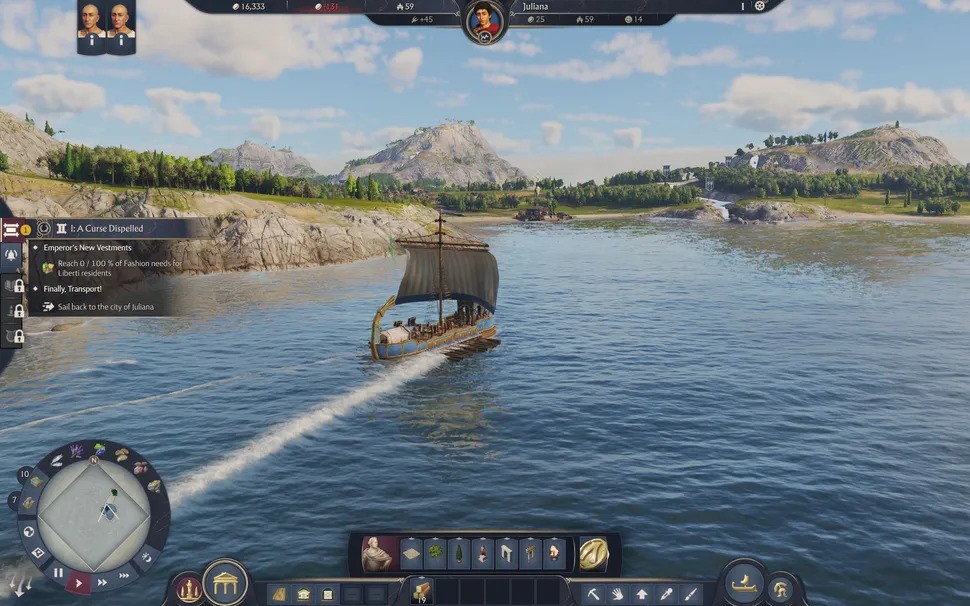
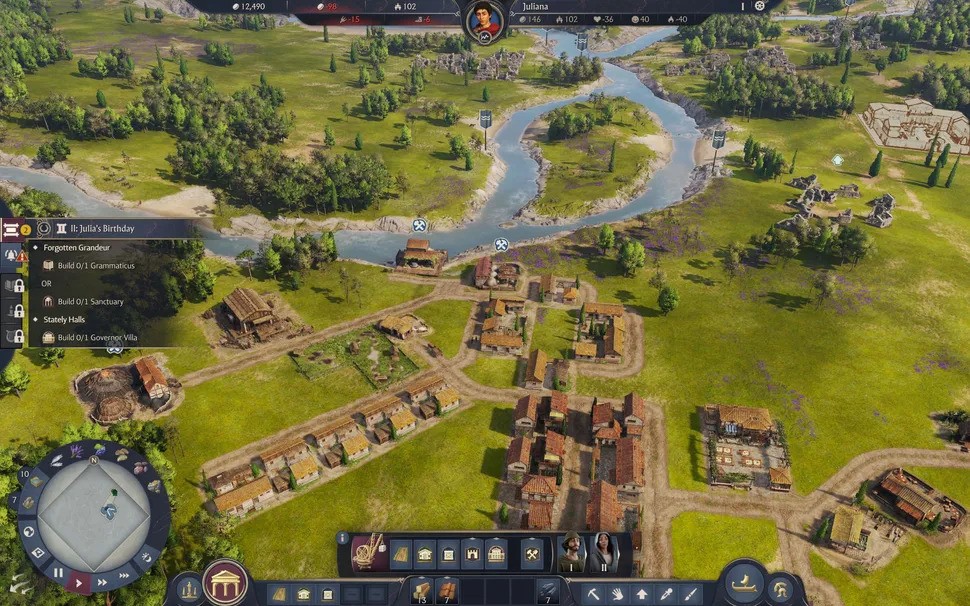
Part of that comes from the complexity of its systems, but a huge reason is simply how stunning Anno 117: Pax Romana looks. Whether I was sailing ships across the sea, watching weather transitions and day-night cycles, or zooming in to observe my citizens living their lives, I was constantly amazed by the detail.
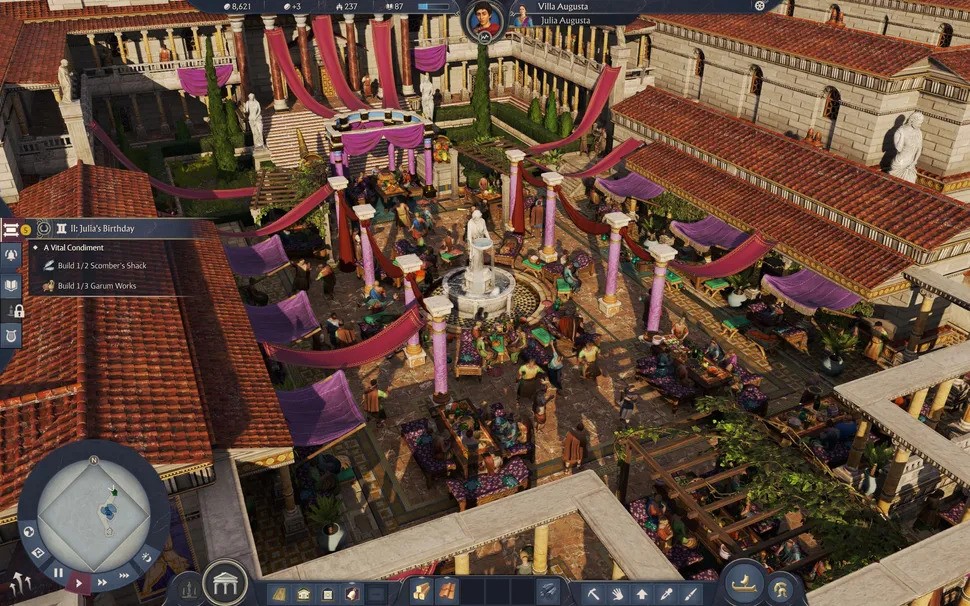
One evening I watched citizens drinking in a courtyard, flies buzzing around a disease outbreak near another house, trees and grass moving naturally in the wind, and Medici workers rushing to solve health problems. The world feels incredibly alive.
Co-Op and Endless Replayability
My final experience before writing this review was testing the co-op mode, and even though I didn’t fall into another twenty-hour session immediately, I’m genuinely excited to continue playing with friends.
Sandbox mode supports up to three additional leaders, which can either be AI factions or real players. You can also fully share the same save file and build together as one civilization. There’s even a “Live Game” feature that allows other players to continue building inside your world through cloud saves while you’re offline.
I’m not entirely sure I trust anyone enough for that.
Final Thoughts
Overall, Anno 117: Pax Romana feels like the ultimate city builder — filled with story, endless replayability, and one of the most beautiful worlds I’ve explored in the genre. I do wish the game offered more guidance for newer players, but even so, I genuinely cannot wait to jump back in and see what else it still has to offer.
A review copy of the game was provided by Ubisoft
Ako tražite povoljnije cene za igre, DLC-ove i druge digitalne proizvode, posetite Eneba i pogledajte aktuelnu ponudu.
Pre kupovine obavezno unesite naš promo kod BUFFGAMING i ostvarite dodatnih 5% popusta.
Kupi igre, poklon-kartice i dopune povoljnije