

Castlevania: Belmont’s Curse: delivers a strong return to classic 2D action, with satisfying combat, striking gothic visuals, and an excellent soundtrack. While its exploration and platforming play things relatively safe, it remains a highly enjoyable adventure for fans of the series. – NikolaOtasevic
After a long period in which fans of the series have mostly had to make do with remasters, collections, and occasional reminders of its rich history, Castlevania: Belmont’s Curse finally delivers a brand-new adventure that brings the franchise back to its 2D roots. Development was entrusted to Evil Empire, the studio known for its work on Dead Cells, which immediately raised an interesting question: can a team that successfully modernized roguelite action find the right balance between contemporary game design and the traditional Castlevania experience?
The answer is largely yes, as Belmont’s Curse manages to combine the series’ signature gothic horror atmosphere, challenging combat, and castle exploration into an adventure that feels like a natural continuation of its legacy. However, not every aspect is equally impressive, as some ideas rely on familiar conventions without making much effort to improve upon them. The result is a game that understands what makes Castlevania special, but occasionally leaves you wondering whether it could have been bolder in certain areas.
A New Generation of the Belmont Family
The story takes place between the events of Castlevania: Curse of Darkness and the original Castlevania, with Rose Belmont, Trevor Belmont’s daughter, at its center. When the forces of darkness threaten France, the Church calls upon Trevor for help. He accepts the mission and brings Rose along to introduce her to the family trade of vampire hunting. Her position is particularly interesting because she combines the powers of the Belmont and Belnades families, while also dealing with the consequences of the curse Dracula passed on to her mother.
This premise provides a solid foundation for a new story within an already familiar universe, especially for players who want to see how the legacy of the legendary vampire hunters continues through a new generation. Although Belmont’s Curse does not stray too far from the series’ established themes, it attempts to connect several events from the wider Castlevania timeline and lay the groundwork for future games to build upon.
The greatest strength of its narrative approach is how naturally everything fits into the atmosphere the series is known for, without unnecessarily complicating the central premise. Belmont’s Curse does not attempt to change Castlevania’s identity, but rather introduce it to a new audience while providing enough details for longtime fans to recognize connections to previous games.
Combat Is the Game’s Strongest Asset
If there is one area where Evil Empire truly excels, it is the combat system. Players who have spent a lot of time with Dead Cells will notice certain similarities in how attacks connect and how the game expects them to carefully assess enemy behavior, but Belmont’s Curse has a slower, more deliberate pace. Simply attacking an enemy quickly and moving on is not enough, as enemy placement, attack patterns, and the moment you choose to defend yourself are often just as important as your offense.
I particularly like that defense is not reduced to simply dodging everything that comes your way. Rose has access to a slide, a short backward hop, and the ability to crouch from the beginning, with the right response depending on the type of attack you are facing. Certain enemies can still hit you if you try to jump over them or dodge by moving behind their backs, while crouching is a much safer option in these situations and allows you to counterattack immediately.
These encounters are precisely what make the combat interesting, as the game demands more than quick reflexes; you also need to recognize what an enemy is about to do. Every encounter becomes a small test of judgment and proper timing, and this approach works just as well against regular enemies as it does during boss fights. The difficulty generally meets expectations for a Castlevania game, although players accustomed to faster action titles may adapt to this system more easily than those who expect to resolve every encounter through relentless aggression.
There is, however, one design decision that slightly undermines the balance. The progression system and items that increase attack and defense can make some of the later challenges so much easier that they diminish part of the original difficulty. This is not a problem that ruins the combat, but a more careful balance between progression and difficulty could have preserved the intensity that makes this system so good.

Difficulty That Accommodates Different Players
Belmont’s Curse does not offer the traditional difficulty selection found in many modern action games, but it still allows players to adjust several important parameters, including the amount of experience they earn, the damage they deal, and the damage they receive. The default settings deliver the kind of experience you would expect from a traditional Castlevania game, while additional modifiers allow you to make the adventure more challenging or more accessible according to your preferences.
This is a sensible compromise between preserving the series’ identity and making it accessible to newcomers. Rather than dividing the entire game into several predefined difficulty levels, you can adjust individual elements without completely changing how the game plays. Since combat requires you to observe your opponents carefully and use defensive moves correctly, this flexibility can be useful for players who need more room to master the mechanics.
The problem only arises when a combination of upgrades and more forgiving settings becomes a way to push through certain challenges simply by dealing more damage. Even so, this is more a question of balance for a particular type of player than a serious flaw in the overall system, especially since the core combat remains engaging enough to reward learning enemy patterns and reacting precisely.
Exploration Plays It Safe
While combat represents the game’s biggest achievement, castle exploration and puzzle-solving leave a somewhat weaker impression. The main progression system revolves around Rose’s tarot cards, each representing a particular arcana that you can unlock. Some are obtained after boss fights, while others require you to find a specific route, solve a puzzle, or acquire an ability that grants access to a previously inaccessible part of the map.
On paper, this is a perfectly solid foundation for a metroidvania adventure, but the puzzles themselves rely largely on familiar ideas. Hidden passages, false walls, background details, and clues obtained through conversations with characters are all standard genre conventions, so experienced players probably will not encounter many moments that force them to completely rethink their approach to make progress.
That does not mean exploration is bad; it simply lacks a few memorable ideas that could make it as distinctive as the combat. Belmont’s Curse generally succeeds in keeping you interested in the next section of the castle and rewarding thorough exploration, but it rarely creates that special feeling of surprise when you discover a completely unexpected route or realize that you had far more options available than you initially thought.
As a result, the game works better as a well-crafted introduction to the Castlevania formula than as a title attempting to push the boundaries of the metroidvania genre. For someone new to these games, that can be an advantage, but fans who already have plenty of experience with indie metroidvanias will probably want a more ambitious approach to exploration.
The Whip Still Matters, but Movement Offers Few Surprises
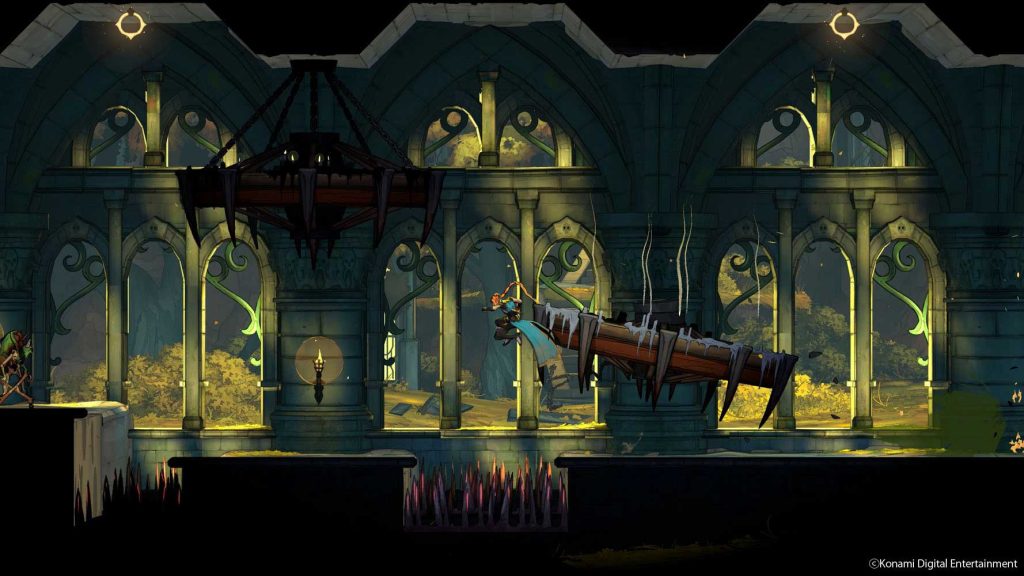
Movement through the castle is another area where Belmont’s Curse largely sticks to familiar territory. Rose has a double jump and an air dash, while the whip and grapple points are her most important tools for overcoming obstacles. Many rooms require you to string these abilities together into a continuous sequence of movements, forcing you to judge when to swing, when to change direction, and how to use your momentum to reach the next platform.
These sequences can be enjoyable, especially when you successfully chain several moves together without interrupting your momentum, but Rose’s abilities do not evolve enough to make exploration feel dramatically different later in the game. In some other titles within the genre, progression gradually unlocks a whole range of new ways to navigate previously visited areas. Here, most of the challenge comes from making better use of the tools you already have.
The whip is therefore the centerpiece of this part of the game, serving both as a weapon and as a means of navigating the environment. Platforming sequences require a degree of precision, but they generally do not attempt to introduce radically new mechanics or demand particularly unusual solutions. Compared with games that significantly expand your movement options as the adventure progresses, Belmont’s Curse feels fairly traditional. That is not necessarily a bad thing, but it certainly leaves room for improvement.
A Gothic Aesthetic That Immediately Captivates
The visual presentation is one of the game’s most striking elements and an area where Belmont’s Curse gives you very little reason to complain. The combination of 2D portraits and animated sequences with stylized 2.5D environments allows the story and gameplay to be presented in different ways while maintaining a consistent artistic identity. Everything is built around the series’ recognizable gothic aesthetic, from chapels and towering clock towers to lavish halls filled with mirrors and paintings.
It is particularly commendable that the visual improvements do not come at the expense of Castlevania’s recognizable look. The game feels modern and detailed, but it does not try to hide its 2D identity behind excessive effects or an unnecessarily realistic presentation. The animations are also excellent, and their role is not merely aesthetic, as they clearly communicate an enemy’s attack preparation, its direction, and the moment when you need to react. In a game that relies so heavily on precise timing, this clarity is an important part of the design rather than just visual decoration.
The music is equally successful and perfectly complements the atmosphere of the castle. Alongside new compositions, the soundtrack features recognizable themes such as “Bloody Tears” and “Vampire Killer” in new arrangements, which should be particularly exciting for longtime fans. However, the soundtrack does not rely solely on nostalgia, as the new compositions have enough character to complement the visual style and remain memorable beyond the individual scenes in which they appear.
When you combine the excellent animations, gothic architecture, memorable characters, and music that understands the series’ legacy, it becomes clear that Evil Empire knows exactly what makes Castlevania distinctive. The presentation is one of the strongest reasons why Belmont’s Curse feels like a worthy return for this beloved franchise.

How Much Content Does Belmont’s Curse Offer?
Completing the main adventure takes approximately 15 to 25 hours, depending on how thoroughly you explore the castle and how much additional content you want to discover. That is a good length for a metroidvania of this kind, giving you enough time to learn the combat system, master the platforming, and explore the different areas without stretching the experience to the point where it begins to feel tedious.
Three different endings provide additional replay value, encouraging you to pay attention to your exploration if you want to see everything the game has to offer. The structure also accommodates faster playthroughs, which could appeal to players interested in speedrunning. However, the relatively rigid structure leaves little room to experiment with the order of events or discover major shortcuts that would completely change how the adventure unfolds.
The PC version supports both keyboard and mouse, along with fully remappable controls, although a controller is probably the most natural choice for this type of game. There is also a minor inconvenience when using the map, which is still navigated with the WASD keys rather than simply allowing you to move the cursor with your mouse. You may also encounter occasional issues during gameplay, such as an equipment-related bug that affects fast travel, but the overall technical experience feels stable and functional.
Conclusion
Castlevania: Belmont’s Curse is a very good return for one of the most important franchises in the history of action-adventure games. Evil Empire has managed to preserve the gothic atmosphere, recognizable visual identity, and challenging combat that Castlevania is known for, while adapting the experience for modern players. The combat system is unquestionably the game’s strongest element, demanding careful observation of enemies, precise reactions, and smart use of defensive moves, while the excellent presentation and soundtrack further strengthen the overall experience.
On the other hand, exploration and platforming mostly rely on tried-and-tested conventions, meaning the game rarely surprises more experienced fans of the metroidvania genre. Some ideas feel like safe choices rather than attempts to take the series in a new direction, but that does not stop Belmont’s Curse from delivering a polished and enjoyable adventure.
This may not be a game that completely changes how we look at Castlevania, but it proves that the franchise still has a place in the modern gaming industry. For longtime fans, it is a return to a familiar world, while newcomers get an accessible opportunity to discover why the series has left such a lasting mark. If this is the beginning of a new chapter for Castlevania, Evil Empire has laid a solid foundation on which to build.
The game was played on: PS5.
Ako tražite povoljnije cene za igre, DLC-ove i druge digitalne proizvode, posetite Eneba i pogledajte aktuelnu ponudu.
Pre kupovine obavezno unesite naš promo kod BUFFGAMING i ostvarite dodatnih 5% popusta.
Kupi igre, poklon-kartice i dopune povoljnije