
Final Fantasy Tactics: The Ivalice Chronicles: Final Fantasy Tactics: The Ivalice Chronicles successfully modernizes one of the greatest tactical RPGs ever made without sacrificing the depth and charm that made the original a classic. While the voice acting and lingering grind may not appeal to everyone, the outstanding Job System, strategic combat, and masterfully written story make this the definitive way to experience Ivalice. Whether you're a longtime fan or a newcomer to the genre, this is a tactical RPG that deserves your attention. – NikolaOtasevic
As someone who spent both childhood and adolescence deeply immersed in the world of Final Fantasy Tactics, this review is more than an analysis—it’s a personal tribute.
I first played the original game on the PlayStation 1 in the late ‘90s when I was around ten years old. I still remember staring at the screen for hours, trying to figure out how to defeat Wiegraf in that infamous one-on-one duel against Ramza. I didn’t have a second save slot, so I had to start the game over from scratch. It was frustrating, but it only made me love the game more.
Since then, I’ve completed countless playthroughs, experimented with different builds, spent hours grinding Job Points, and absorbed every detail of its story. For me, Final Fantasy Tactics represents the pinnacle of the tactical JRPG genre—a game with an incredibly deep Job System, endless strategic possibilities, and a narrative that fundamentally shaped how I view storytelling in games.
As a longtime fan, I was thrilled when I heard about Final Fantasy Tactics: The Ivalice Chronicles, a remaster that promised to modernize this beloved classic.
The question is: does it successfully fix the game's aging flaws, preserve the soul of the original, and attract a new generation of players?
Gameplay – Tactical Depth That Still Sets the Standard
At its core, Final Fantasy Tactics: The Ivalice Chronicles remains a turn-based tactical strategy game played on grid-based battlefields, where every movement, positioning choice, and tactical decision can determine victory or defeat.
Characters act according to their stats, speed, and class, making every battle feel like a tense game of chess infused with RPG mechanics.
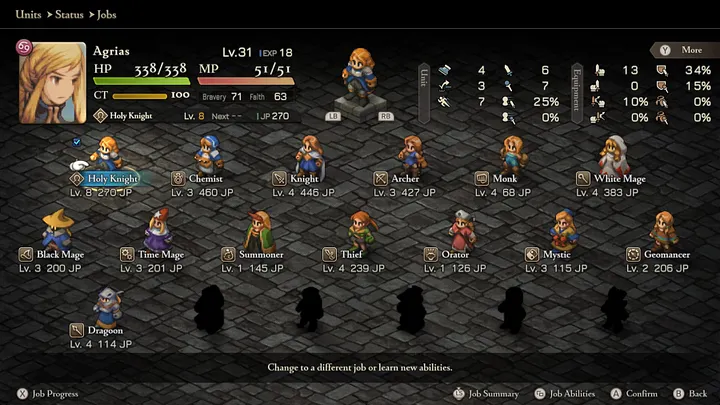
The Job System remains the heart of the experience.
Players begin with basic classes such as Squire and Chemist, but gradually unlock increasingly specialized jobs. These range from physical powerhouses like Knight and Dragoon, to spellcasters such as Black Mage and Summoner, hybrid classes like Monk and Thief, and even more exotic options such as Ninja and Samurai.
What makes the system truly brilliant is its flexibility.
Every character can freely switch jobs while accumulating Job Points (JP) that unlock skills, reactions, passive abilities, and movement options that can later be equipped regardless of the active class.
This allows for nearly endless combinations.
You can create a Knight who uses healing Items, a Black Mage equipped with Time Magic, or countless other custom builds that dramatically change your tactical options.
Back in the original game, this level of freedom felt revolutionary.
However, it also required an enormous amount of grinding.
I still remember spending entire weekends farming JP in random battles just to unlock advanced jobs like Dark Knight or Calculator.
The remaster significantly improves this process through several modern quality-of-life enhancements.
New tutorials explain mechanics step-by-step, movement can now be reset before confirming actions, and battle-search tools make it easier to find specific encounters.
Difficulty options have also been added.Veterans can enjoy the classic challenge, while newcomers can choose a more forgiving experience that makes the game easier to learn. This is arguably one of the remaster’s greatest strengths. The original could be brutally unforgiving, especially during notorious difficulty spikes such as Riovanes Castle.Now the game is much more approachable while still retaining its strategic depth.
That said, the grind never fully disappears. Players who want perfect builds will still need to invest significant time into character development.
As an adult with far less free time than I had in the late ‘90s, I find this aspect less appealing than I once did. However, for many longtime fans, that grind remains part of the game's charm.
Compared to modern tactical RPGs such as Fire Emblem Engage and Triangle Strategy, it’s remarkable just how far ahead of its time Final Fantasy Tactics truly was.
Story and Themes – A Masterclass in Political Storytelling
For me, Final Fantasy Tactics features one of the strongest narratives in the entire Final Fantasy franchise.
It’s complex, political, mature, and deeply human without relying on overused tropes such as amnesia or multiverse storytelling.
Presented as a historical investigation, the story gradually uncovers the truth behind the War of the Lions in Ivalice.
Two noble factions fight for control of the throne, but beneath the surface lies a much deeper tale involving class conflict, betrayal, corruption, and manipulation by both the nobility and the Church.
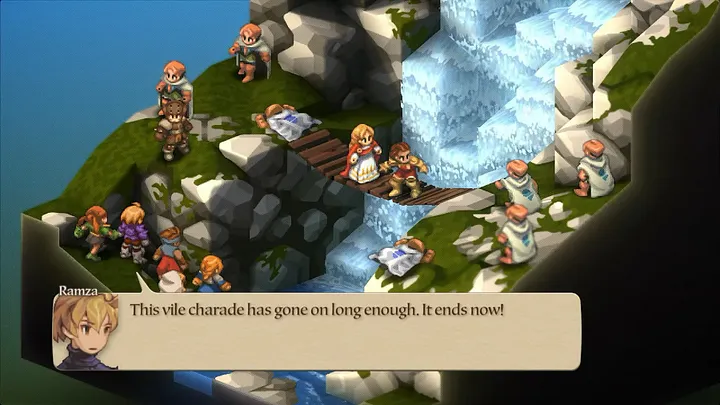
Ramza Beoulve begins as an idealistic young nobleman but gradually transforms into a forgotten hero whose sacrifices are erased from history.
Meanwhile, his childhood friend Delita rises through the ranks by manipulating the system for his own purposes.
As a fan of the original, I’ve always loved how the story explores themes of class inequality, honor, sacrifice, and political power.
In many ways, it feels closer to Game of Thrones or Machiavelli’s writings than a traditional fantasy RPG.
The newly added voice acting brings additional life to many scenes, though its execution isn’t always perfect.
Still, hearing these characters speak adds another layer to a story that remains one of gaming’s finest narratives.
Compared to modern entries like Final Fantasy XVI, Tactics feels refreshingly focused and free from unnecessary filler.
Its themes remain just as relevant today as they were decades ago.
Presentation – Nostalgia with Modern Enhancements
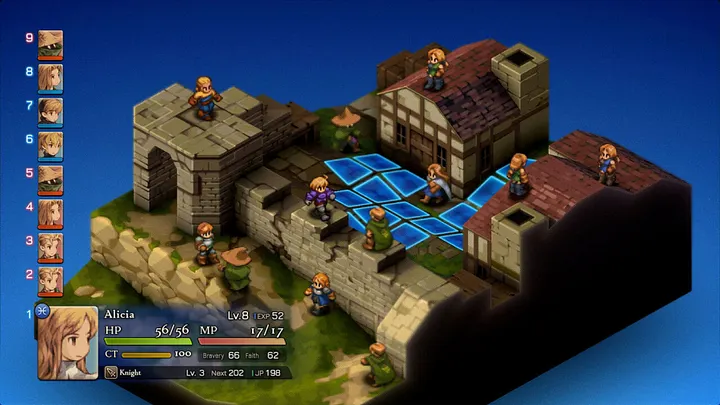
The original game's pixel-art visuals and isometric perspective were impressive for their time, but the remaster successfully modernizes them.
Sharper character sprites, richer colors, and improved resolution make the game look fantastic on modern displays, especially handheld systems.
Performance is flawless throughout.
Unlike the PSP version, there are no major slowdowns, stutters, or technical issues.
Text corrections and interface improvements further enhance the overall experience.
The soundtrack remains outstanding.
Its orchestral compositions perfectly capture both the tension of battle and the emotional weight of key story moments.
While some sound effects have been altered, not every change is necessarily an improvement.
For example, the classic defeat screams have been replaced with more subdued grunts, which slightly diminishes some of the original’s charm.
Still, the presentation overall is undeniably improved.
Voice Acting – A Step Forward or a Step Back?
The addition of voice acting will likely divide fans. While it's certainly appreciated, many performances feel strangely restrained. Characters who should sound furious often come across as calm and detached, reducing the emotional impact of several key scenes. As someone who spent years imagining these characters’ voices while reading the original dialogue, I occasionally found the voice acting more distracting than immersive. The sprite-based presentation also makes emotional performances harder to sell, and the lack of proper lip-syncing doesn’t help. Compared to modern RPGs such as Baldur's Gate 3, the performances simply lack the same level of depth and personality. Personally, I ended up disabling the voices after a few hours and returned to reading the dialogue myself.
Criticisms and Weaknesses
While the remaster fixes many of the original game's issues, some problems remain.
Grinding can still become repetitive.
Certain fans may prefer the raw pixel-art style of the original game over the cleaner remastered visuals. The absence of some content from the PSP version, particularly additional War of the Lions material, may disappoint veterans.The narrative is also incredibly dense and occasionally difficult for newcomers to follow. Its archaic language and large cast of characters demand patience and attention. Comparisons with games such as Tactics Ogre: Reborn highlight both the strengths and weaknesses of Final Fantasy Tactics. Its Job System remains superior, but its difficulty balancing can occasionally feel less refined.
Final Verdict – 9/10
Final Fantasy Tactics: The Ivalice Chronicles is a triumphant remaster.
It successfully makes one of the greatest tactical RPGs ever created more accessible while preserving everything that made the original special.
As someone who spent hundreds of hours with the PlayStation classic, I was thrilled to revisit Ivalice once again.
The new quality-of-life features, visual improvements, and smoother gameplay make this the definitive version of the game.
While the voice acting and lingering grind prevent it from achieving perfection, those flaws do little to diminish its greatness.
For veterans, this is a wonderful dose of nostalgia.
For newcomers, it is the perfect introduction to one of the most important tactical RPGs ever made.
If you love strategy, deep character customization, and mature storytelling, this is an experience you absolutely should not miss.
A review copy of the game was provided by IrisMega.
Ako tražite povoljnije cene za igre, DLC-ove i druge digitalne proizvode, posetite Eneba i pogledajte aktuelnu ponudu.
Pre kupovine obavezno unesite naš promo kod BUFFGAMING i ostvarite dodatnih 5% popusta.
Kupi igre, poklon-kartice i dopune povoljnije