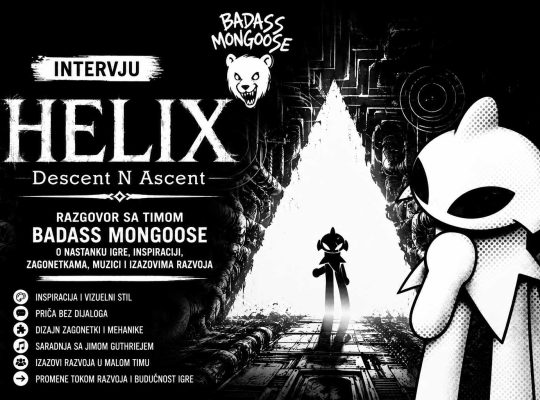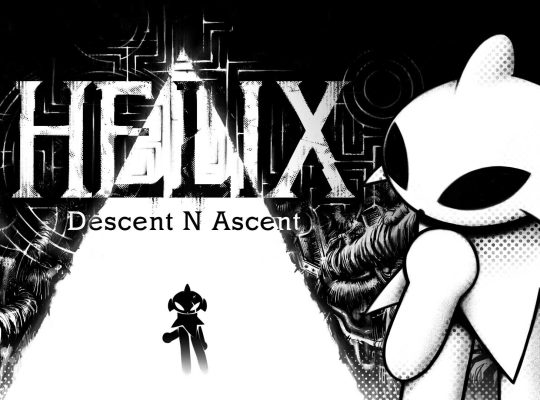

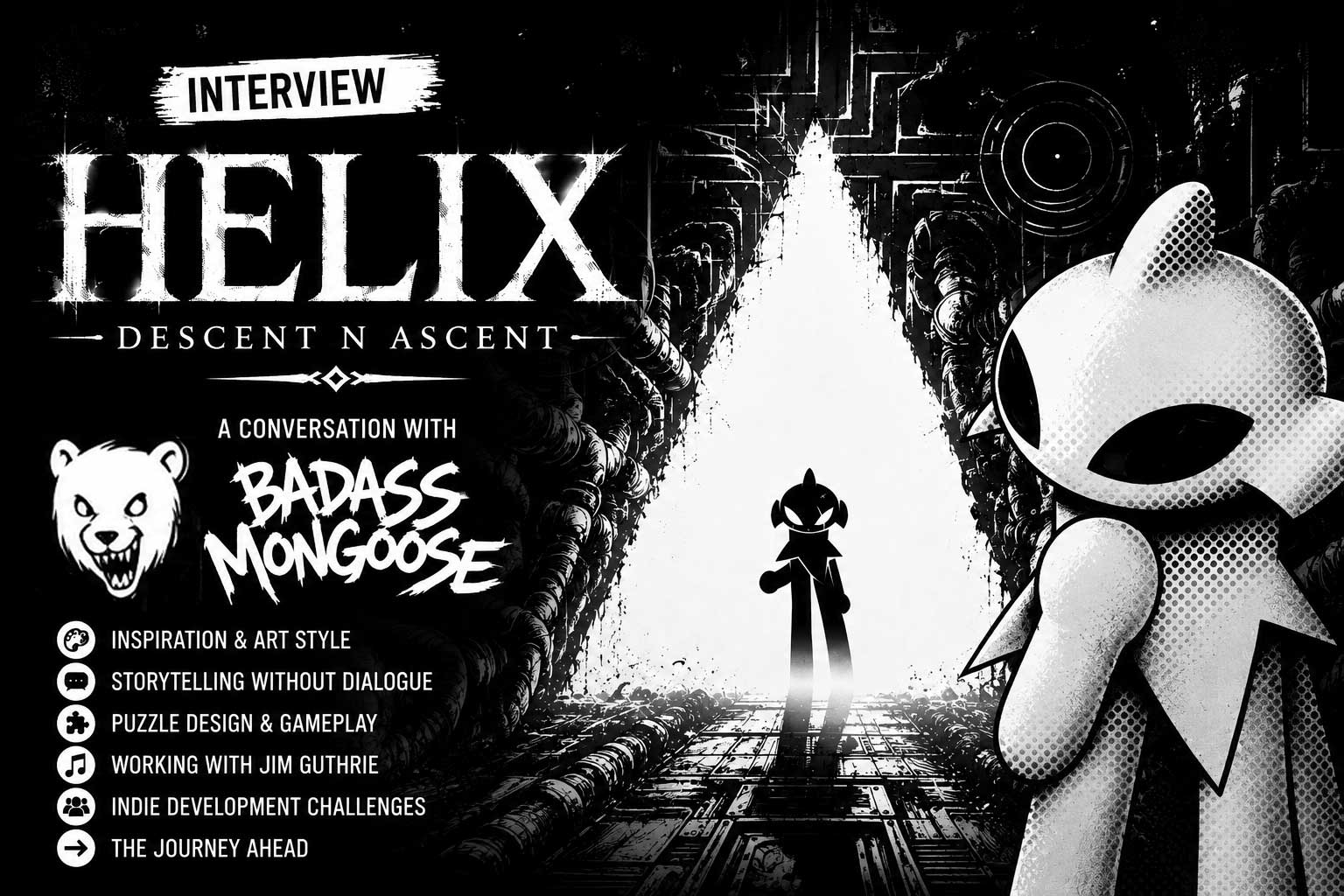
Helix: Descent N Ascent is one of this year's most intriguing indie puzzle adventures. With its striking monochrome art style, atmospheric world, and cleverly designed puzzles, the game has managed to stand out in an increasingly crowded indie landscape.
After spending time with the game for our review, we also had the opportunity to sit down with the developers at Badass Mongoose. We talked about the origins of Helix's unique visual identity, the comic book artists who inspired its world, the challenges of telling a story without dialogue, designing puzzles that reward experimentation, working with composer Jim Guthrie, and the realities of bringing such an ambitious project to life as a small independent studio.
Here's what the team had to say about the creative journey behind Helix: Descent N Ascent.
BuffGaming :
Helix: Descent N Ascent immediately stands out with its striking black-and-white visual identity. What inspired this artistic direction, and how early in development was that decision made?
Badass Mongoose :
In its earliest stages, the game had a more generic look. Then one day, while I was wandering around in a bookshop, I came across the art book for Gris, and I realised at that moment that we needed to make our game visually distinctive. The decision to opt for a monochrome design was firstly to stand out from the vast array of titles released every month and secondly, out of love for pure drawing and as an homage to the comic books we cherish!
Badass Mongoose :
The game draws inspiration from 1980s indie comics, 1990s manga, and Franco-Belgian comics.
BuffGaming :
Which specific artists or works had the biggest influence on the final look of Helix?
Badass Mongoose :
Kevin Eastman and Peter Laird (TMNT, Mirage era); Yukito Kishiro (GUNNM / Battle Angel Alita); Philippe Druillet, Enki Bilal and Moebius (Metal Hurlant).
BuffGaming :
The story is told almost entirely without dialogue. What challenges did that create when trying to build an emotional connection with players?
Badass Mongoose :
The biggest challenge is to give the player enough material to work with, then provide a meaningful conclusion while maintaining elements of mystery the whole time. As of now, we can’t tell you whether we’ve succeeded in that task. Ultimately, it’s up to the players to decide whether they feel an emotional connection.
BuffGaming :
The game explores themes such as identity, solitude, and relationships. How important was it for you to leave room for players to interpret the story in their own way?
Badass Mongoose :
This has been at the back of our minds from the beginning and is very important to us. We don't want to restrict players’ imagination by imposing a rigid narrative structure. We show some key moments of the story, but we also leave some blanks to be filled. We are very curious to see what stories and theories they come up with.
BuffGaming :
Helix focuses on puzzle-solving rather than combat. Was avoiding violence a creative decision from the very beginning, or did the project evolve in that direction over time?
Badass Mongoose :
The idea is both creative and practical. On the one hand, we wanted to create a reflective game that was disguised as an adventure game. On the other hand, we needed to reduce the scope to fit our limited budget. Implementing combat would require a lot of animation for the main character and all the enemies. That's not something we could afford. However, this restriction forced us to think creatively in ways we wouldn't have otherwise.
BuffGaming :
The ability-combination system looks like one of the game's core mechanics. How did you approach designing puzzles that encourage experimentation without frustrating players?
Badass Mongoose :
We tried to balance it, but ultimately it's up to the players to judge whether they feel frustrated. Our focus was on the ergonomics. There’s a lot of manipulation involved, so we tried to make the controls as smooth as possible.
BuffGaming :
Jim Guthrie's music plays a major role in creating the game's atmosphere. How did this collaboration come about, and how closely did the soundtrack influence the game's design?
Badass Mongoose :
We got in touch with him very early on. While we were prototyping, we sent him a few sketches and a pitch. We wanted to find out as soon as possible whether his contribution would be possible later on, as we’d had his music in mind from the get-go. We sent him footage of the first level and he produced an initial track for Helix (Silent Walls). Then I spent time sketching while listening to that track on repeat.
BuffGaming :
Badass Mongoose is a relatively small team. What has been the biggest challenge in bringing such an ambitious artistic vision to life?
Badass Mongoose :
Time and money are limited. It has been a five-year journey, and not the calmest. Finding enough time to produce all the assets we needed to render our vision was challenging. Then finding enough money to outsource what we couldn't do ourselves (music, SFX, main character animation and VFX) was another challenge.
BuffGaming :
Looking back on development, is there a feature, mechanic, or visual element that changed the most compared to your original concept?
Badass Mongoose :
The whole thing evolved quite a lot. The core principles remained constant: There are five distinct abilities, and you can have up to three at the same time, which makes 25 glyphs (runes or symbols) to collect. Almost everything else has undergone one or more iterations, including the main character.
BuffGaming :
Finally, what do you hope players will be thinking or feeling when they reach the end of Helix: Descent N Ascent?
Badass Mongoose :
The accomplishment and satisfaction of reaching the end of that journey.