
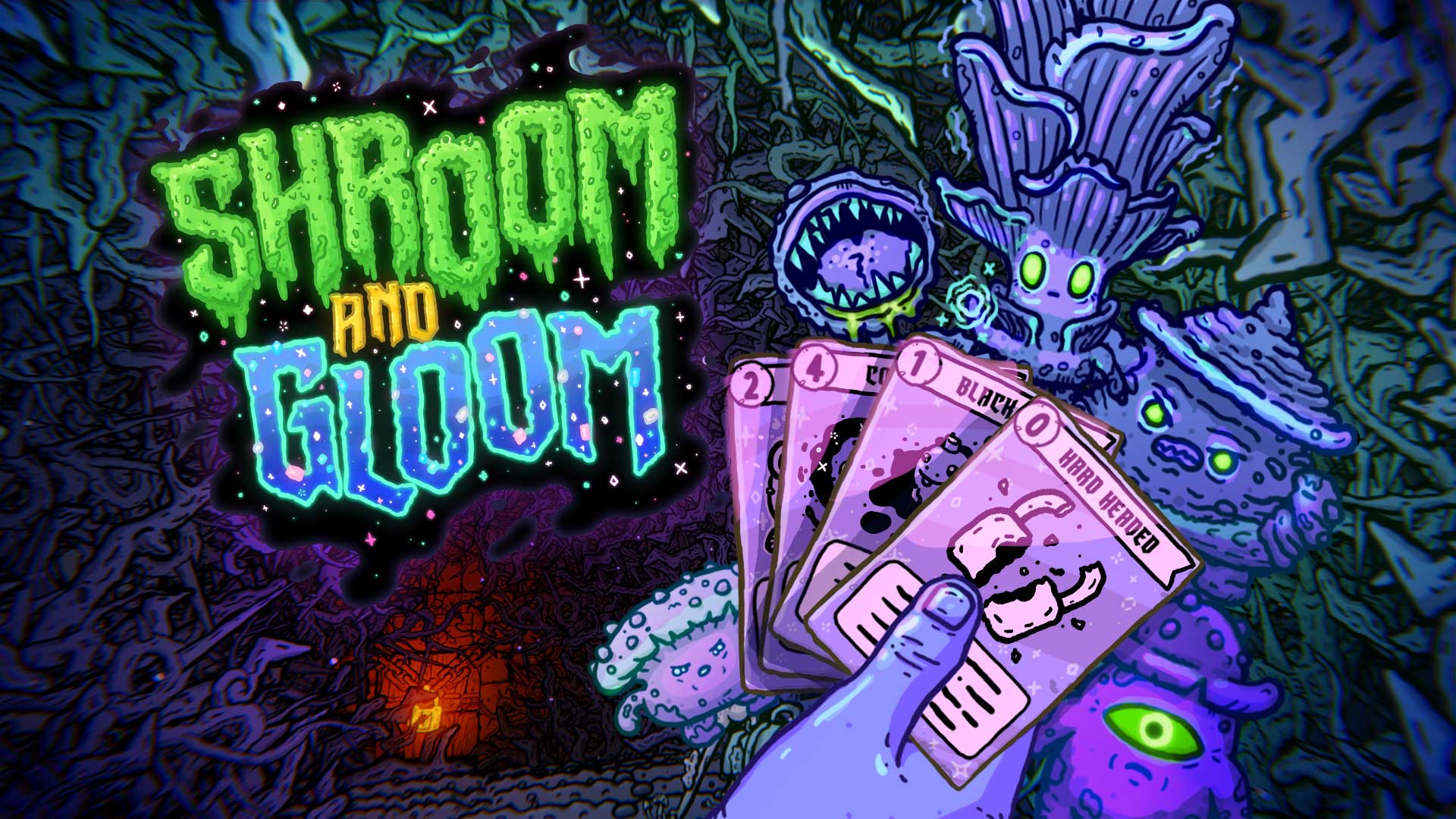
Shroom & Gloom: Shroom & Gloom already shows in Early Access how well its idea of two completely different but interconnected decks can work. The first-person perspective, exploration, combat and bizarre enemy-eating system give the game an identity that is difficult to find elsewhere in the deckbuilding genre. There is still not enough content for the experience to feel completely rounded out, but the foundation is excellent and the potential is considerable. – NikolaOtasevic
Shroom & Gloom is one of the more interesting deckbuilders I have played recently, largely because it refuses to simply follow the formula we have seen countless times before. It combines a first-person perspective with roguelike mechanics and builds its entire experience around two completely separate decks. One is used for combat, while the other is dedicated to exploring the game's strange, hand-drawn dungeons. The real appeal, however, comes from how closely these two systems are connected.
Instead of simply watching cards appear on the screen and deciding which one to play, you actually move through fungal-filled dungeons, explore rooms, unlock paths and search for useful resources before heading into the next encounter. Once combat begins, the focus shifts to your other deck, but the decisions you made while exploring can directly affect what happens next. The result is an experience that is difficult to confuse with a traditional deckbuilder.
Two Decks That Constantly Work Together
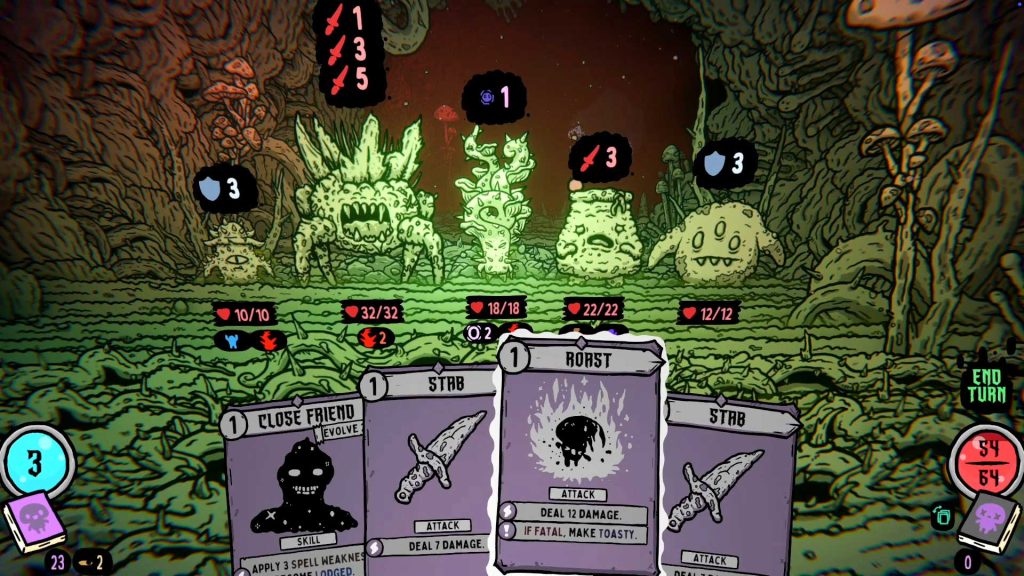
The central idea behind Shroom & Gloom may sound simple, but it is what makes the game stand out. You have a combat deck, which is used during fights, and an exploration deck, which takes over when you are moving through the dungeon. On paper, these are two separate systems, but it does not take long to realize that neither works properly without the other.
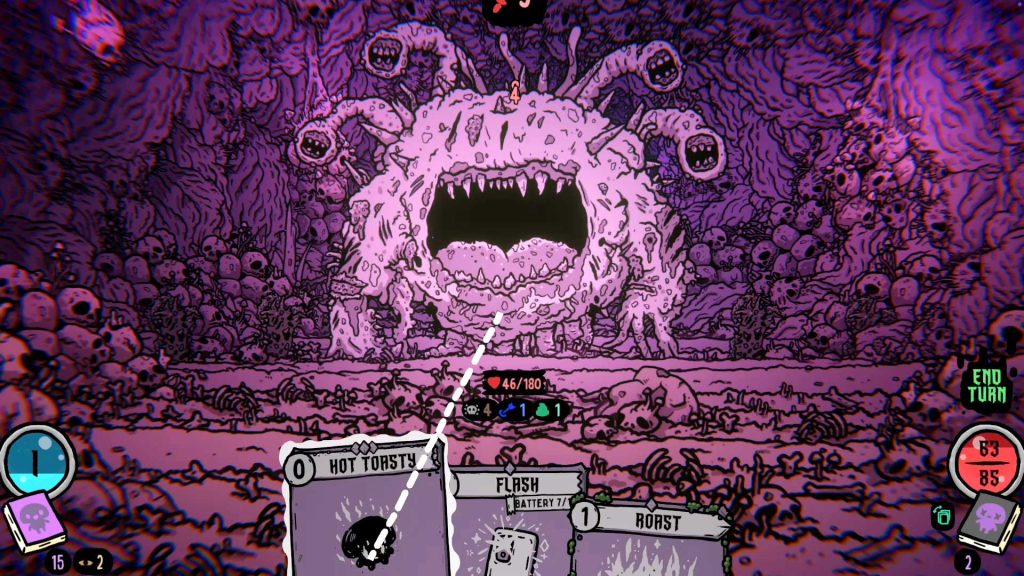
The combat deck offers what you would expect from a deckbuilder: attacks, different effects, debuffs and various ways of preparing yourself for what comes next. However, the game takes a rather unusual approach to healing. Instead of relying on traditional blocking and healing mechanics, you restore your health by eating your enemies. That sounds bizarre enough on its own, but the way the system is implemented makes it much more interesting than you might expect.
You can season enemies, cook them, put them on a skewer or simply eat them raw. The better you prepare what you are about to consume, the more benefits you can get from it. This means combat is not simply about dealing as much damage as possible, but also about deciding when the right moment has arrived to turn an enemy into your next meal. Once you start connecting several effects and building combinations, this strange system becomes one of the most enjoyable parts of the game.
The exploration deck may be even more important than it initially appears. Between battles, you actually move through the environment, exploring corridors and rooms while using cards for different interactions. You can use them to unlock doors, dig, turn on lights, feed animals, break certain objects or discover hidden cards. Since you have a limited number of actions, you cannot simply interact with everything without thinking. You need to consider what you need at that particular moment and what will be most useful further ahead.
This is where the connection between the two decks really shines. What you discover or upgrade while exploring can directly affect your next battle, while what you do in combat determines how many resources you will have available for continued exploration. Instead of simply switching the player from one mode to another, both systems constantly feed into each other, making the entire run feel like one connected experience.
When Eating Enemies Becomes a Strategy
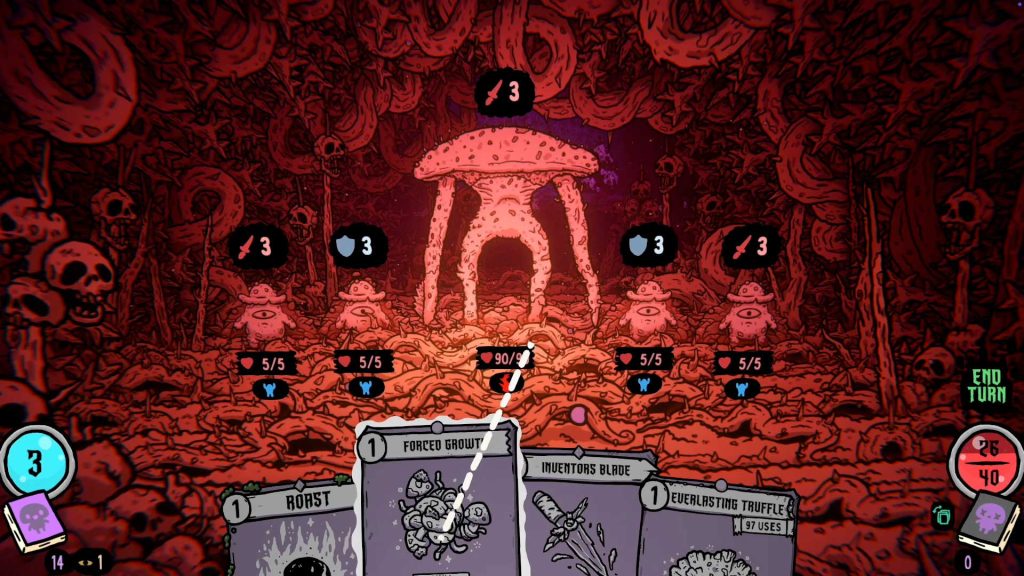
One of the best examples of how Shroom & Gloom manages to do something different is its healing system. In most deckbuilders, you quickly learn that protecting your character and minimizing damage is important. Here, the philosophy is completely different. An enemy is not simply an obstacle that needs to be eliminated; it is also a potential source of health.
Because of this, the way you finish a fight can be just as important as winning it. You might want to prepare an enemy in a specific way before eating it, try to create a combination that allows you to get as much benefit as possible from a single enemy, or decide that saving a particular card for later is more important than ending the encounter immediately.
These decisions give the system additional depth and prevent combat from becoming a simple matter of drawing random cards and hoping for the best. There is still a roguelike element of randomness, of course, but the game relies heavily on how well you understand its systems and how effectively you can connect them.
Exploration Is More Than a Break Between Battles
The first-person perspective is not simply a visual gimmick. It significantly changes the way exploration feels. Instead of looking at a map from above or moving through a traditional 2D space, you are directly inside the dungeon, looking at what is in front of you and deciding which interactions are worth using.
The limited number of actions reinforces the feeling that every move needs to matter. You cannot mindlessly spend everything you have because you never know what might be waiting behind the next door. As a result, exploration has its own sense of tension, even when there is no immediate combat.
I particularly like the fact that exploration does not feel like a mandatory section you simply have to get through before reaching the next enemy. It is another part of the strategy and often forces you to think several moves ahead. If you make good use of what the environment offers, your next encounter can become considerably easier.
A Visual Identity That Is Hard to Forget
One of the first things that stands out is the game's art direction. Hand-drawn elements are combined with 3D environments in a way that gives the entire world an almost tactile appearance. Everything looks as though it has been made from paper, clay and, naturally, a ridiculous amount of strange mushrooms.
The atmosphere is simultaneously dark, slightly disgusting and surprisingly charming. The game is not trying to create a traditional horror world, instead using grotesque details and unusual designs to create its own identity. Because of this, it is difficult to mistake Shroom & Gloom for another deckbuilder as soon as you see it in motion.
That visual presentation also works particularly well with the first-person perspective. The dungeons feel like physical spaces you are actually moving through, while the hand-drawn elements create the impression that you are walking inside some bizarre illustration that has suddenly come to life.
Five Characters and Plenty of Room for Experimentation
The Early Access version currently features five playable characters, each with a different starting deck. This is important because changing characters does not simply mean changing the appearance of your protagonist; it also changes the way each run begins.
There is meta-progression through unlocks, but the game does not simply try to make you stronger by constantly increasing your stats. Instead, it relies much more on your ability to understand its systems, which I appreciate because it puts greater emphasis on learning and experimentation.
As you become more familiar with the cards and possible combinations, you increasingly start thinking about what kind of build you want to create rather than simply taking whichever card appears to be the strongest. That makes each new run an opportunity to try something different.
An Early Access Build With a Strong Foundation
Shroom & Gloom entered Early Access on September 10, 2026, with two paths leading to Gloom, five characters and a solid selection of cards and enemies. The planned Early Access period is between 12 and 24 months, during which the developers intend to add new paths, cards, enemies and other content.
Although it is obviously not a finished game yet, the current version is quite impressive. The core gameplay works, combat has weight, exploration is more than just a side activity, and the urge to start another run comes very naturally. After several hours, however, you do start to recognize certain patterns and realize that the current content is not yet broad enough to provide endless variety, but that is exactly what we should expect from a game still in Early Access.
More importantly, the foundation is very strong. When a game can already make you think carefully about every move at this stage of development, there is more than enough reason to pay attention to how it develops once all of its planned content begins to arrive.
From a technical standpoint, the experience is stable, and the developers have already started releasing smaller patches, which is another positive sign for a game in this stage of development.
Conclusion
Shroom & Gloom is one of the more interesting deckbuilders I have played recently, especially because it does not simply try to repeat a formula we have already seen countless times. The first-person perspective, two separate decks, environmental exploration and the completely bizarre idea of using enemies as food come together to create an experience with a very distinct identity.
The game's biggest success, however, is not simply that its ideas are unusual, but that those unusual ideas actually make sense when combined. The combat and exploration decks are not just two different systems sitting next to each other; they complement one another and influence how you approach every run. Add an interesting art direction, five playable characters and a solid amount of content already available in Early Access, and you have a very strong foundation for what this game could eventually become.
Of course, there is still not enough content to say that the experience is completely rounded out, and after several hours certain patterns begin to repeat. However, precisely because the core formula is already this strong, Shroom & Gloom is a game worth following from the very beginning of its Early Access journey. If you enjoy roguelike deckbuilders but want something that genuinely feels different from the usual formula, this is a game that already has a very clear idea of what it wants to be.
Early Access Score: 8.5/10
The game was played on: PC.
Ako tražite povoljnije cene za igre, DLC-ove i druge digitalne proizvode, posetite Eneba i pogledajte aktuelnu ponudu.
Pre kupovine obavezno unesite naš promo kod BUFFGAMING i ostvarite dodatnih 5% popusta.
Kupi igre, poklon-kartice i dopune povoljnije