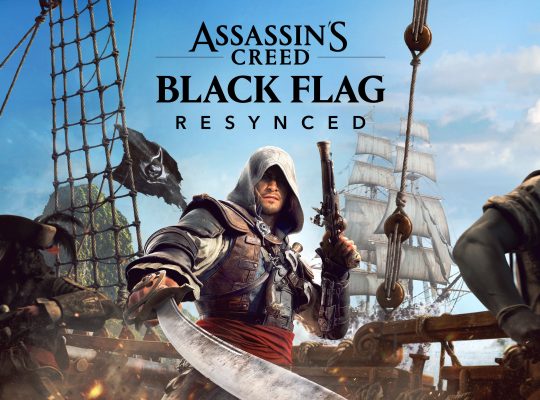

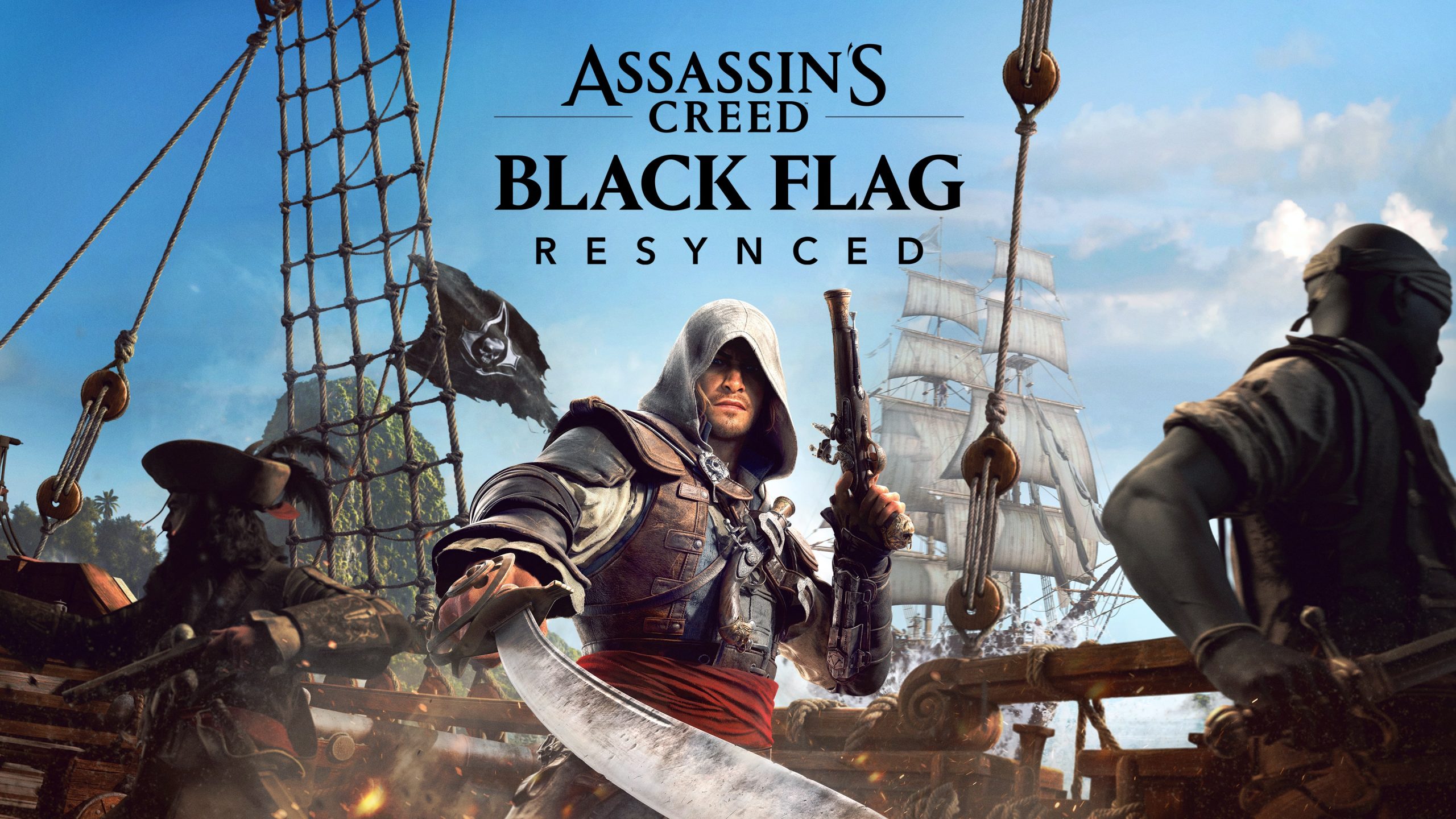
Assassin's Creed Black Flag: Assassin's Creed Black Flag Resynced proves that some games age better than others. While its combat, stealth, and outdated mechanics reveal their age, the incredible naval gameplay, exploration, and unforgettable pirate atmosphere remain unmatched. More than a decade later, Ubisoft still hasn't made a better AAA pirate game. – NemanjaKocica
A Fresh Perspective
Before we dive into the review, there's one important thing I need to get out of the way. I've never been a huge Assassin's Creed fan. In fact, I never finished the original Black Flag, simply because the classic Assassin's Creed gameplay loop never really clicked with me. The only entries in the series I genuinely enjoyed were Origins and Odyssey, mainly because they moved away from the formula that made Assassin's Creed famous in the first place.
That's exactly why my colleague—who's a massive Assassin's Creed fan—and I agreed that I should be the one reviewing Black Flag Resynced. No nostalgia. No rose-tinted memories. Just the perspective of someone experiencing Black Flag properly for the first time in 2026. I honestly believe that's what makes this review different.
Ubisoft Plays It Safe
The last few years haven't exactly been kind to Ubisoft.
After the disappointing performance of games like Star Wars Outlaws, the endlessly delayed Skull and Bones—which spent so long in development that it felt like the real Golden Age of Piracy might return before the game actually launched—and Assassin's Creed Shadows, which sold reasonably well but failed to become the comeback Ubisoft desperately needed, the company was in a difficult position. At that point, bringing back Black Flag was probably the safest decision they could have made. More importantly, Black Flag is still, to this day, one of the only true AAA pirate games on the market.
That alone says a lot about how much players still crave pirate adventures. The success of games like Wind Rose proves there's still a huge appetite for sailing across open seas, discovering hidden islands, hunting treasure, and engaging in massive naval battles. Many developers have tried to capture that fantasy. Very few have succeeded.
Even more than a decade later, no one has managed to combine open-world exploration, naval combat, and the fantasy of being a pirate quite like Ubisoft did back in 2013.
Story
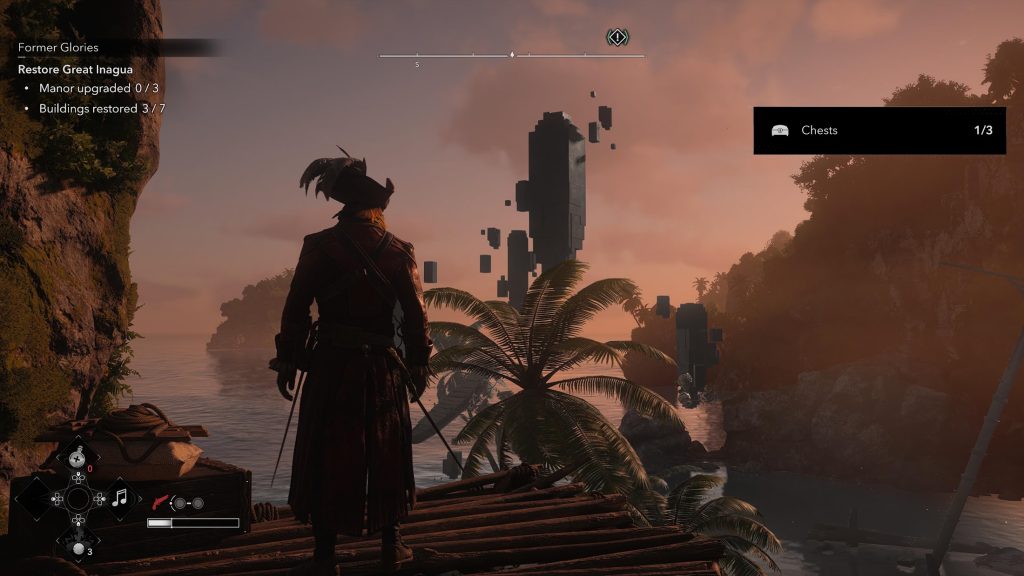
Black Flag follows Edward Kenway, a Welsh privateer and pirate driven almost entirely by wealth, fame, and personal ambition during the Golden Age of Piracy.
After a chance encounter, Edward assumes the identity of the murdered Assassin Duncan Walpole, accidentally pulling himself into the centuries-old conflict between the Assassins and the Templars. Before long, he finds himself caught in a conspiracy surrounding the mysterious Observatory—an ancient First Civilization artifact sought by the Templars.
Even today, Edward remains one of Ubisoft's best-written protagonists. Watching him evolve from a selfish fortune hunter into someone searching for purpose feels surprisingly natural, making him incredibly easy to connect with even if you've never touched an Assassin's Creed game before. Unfortunately, I can't say the same about the three new characters introduced in the Resynced version.
Lucy Baldwin, The Padre, and Deadman Smith are meant to expand the story while unlocking new upgrades for the Jackdaw, but the way they're integrated into Edward's crew feels forced. Their missions aren't bad by any means, but the dialogue and overall writing noticeably stand out—and not in a good way. It's immediately obvious which parts of the story were written over a decade ago and which ones were added recently.
Gameplay
If there's one aspect of Black Flag that's guaranteed to divide players, it's the gameplay. Longtime Assassin's Creed fans will probably feel right at home, but if, like me, you've never been particularly fond of the classic Assassin's Creed formula, gameplay will likely be your biggest obstacle to fully enjoying the experience. Sword combat quickly settles into a predictable rhythm:
Parry. Counter. Kill. Repeat.
Execution animations look stylish and varied, but almost every fight ultimately plays out the same way. The limited variety of enemy types only reinforces that feeling, making encounters become repetitive surprisingly quickly. The biggest issue isn't that the combat lacks mechanics. It's that the game rarely gives you a reason to actually use them. Edward carries four pistols, dual swords, smoke bombs, sleep darts, berserk darts, and several other useful tools.
In practice?
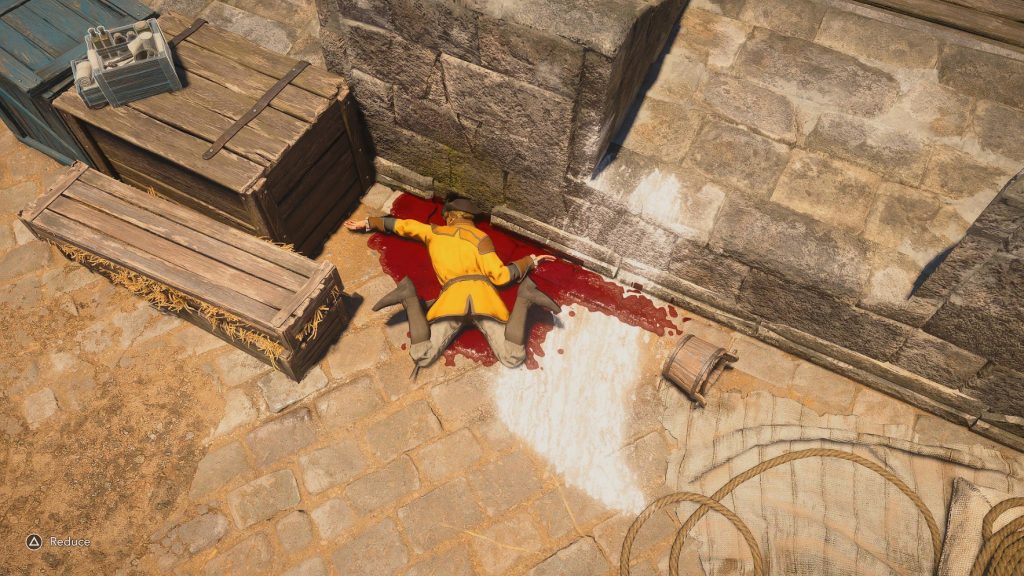
You'll solve most encounters with counters and executions. Everything else feels optional rather than necessary, which is a shame because the combat system clearly had the potential to offer much more variety. The animations haven't aged particularly well either. There are moments where Edward suddenly slows from a full sprint into a casual walk simply because the game wants to trigger an assassination animation. Some double assassinations from ground level look especially awkward, almost as if Edward is jumping several feet into the air before landing on enemies standing right in front of him. They're minor issues individually. After seeing them hundreds of times, though, they become difficult to ignore. Because of that, I often avoided open combat altogether. Not because it was difficult. Quite the opposite. It simply stopped being interesting. Ironically, my biggest complaint isn't the combat. It's stealth. At this point in the story Edward isn't even a true Assassin yet, but stealth is so ridiculously overpowered that it almost makes open combat irrelevant.
Enemy AI is painfully naive.
It isn't uncommon to lure an entire enemy camp toward a single bush and quietly eliminate everyone one by one. At one point I genuinely felt like the guards were politely waiting for their turn, as if they were standing in line at the post office. Instead of encouraging experimentation, the game rewards you for repeating the exact same strategy from beginning to end. Hoping things would become more challenging, I quickly switched the difficulty to Hard. Honestly, the difference isn't dramatic.
Enemies become slightly more aggressive, but the biggest change affects stealth. Guards spot you much faster, which I actually appreciated because it finally forces you to think about positioning and movement instead of casually strolling between enemies. One final thing drove me absolutely insane. Imagine chasing a thief through the streets. You catch up, press Triangle to tackle him… …and Edward decides to stab a random civilian instead because assassination takes priority over tackling.
Suddenly half the city wants you dead. It's one of those small design decisions that probably didn't seem like a big deal back in 2013, but today it feels unnecessarily frustrating and outdated.
Parkour
Parkour in Black Flag is classic Assassin's Creed.
It works well enough that it won't constantly frustrate you, but often enough that it will occasionally make you question your controller. Edward will jump somewhere you never intended, grab the wrong ledge, or suddenly sprint in a completely different direction because the game decided that was the most logical path.
If you've played the older Assassin's Creed titles, you've probably experienced this countless times before. What makes Black Flag different, however, is the world itself.
Forget the towering cathedrals, Renaissance cities, church spires, and enormous landmarks that defined Ezio's adventures. Verticality exists here, but it's a very different kind of verticality.
Most of your time is spent climbing palm trees, jungle ruins, wooden settlements, ships, and tropical islands. Parkour feels far more grounded and natural, perfectly matching the pirate setting. Havana is really the only location that resembles the classic Assassin's Creed city design, while the rest of the world feels much more like one giant pirate playground than a carefully designed urban parkour course. And honestly… That's perfectly fine. Parkour was never the reason I kept coming back to Black Flag. Unlike games such as Assassin's Creed II or Unity, where climbing across rooftops was one of the main attractions, here it's simply a way to move efficiently through the world. Black Flag never tries to be the best Assassin's Creed when it comes to parkour. It wants to be the best pirate game. That's where it truly shines.
Exploration & Sailing
This is where Black Flag reminds you why so many people still consider it one of Ubisoft's greatest games. The very first thing I'd recommend is turning off as many HUD elements, markers, and navigation prompts as possible. It might sound strange, especially in today's world of open-world games filled with icons, but Black Flag becomes significantly better the moment you stop following markers and start following your own curiosity. You stop looking at the compass. You start looking at the world.
Instead of sailing toward the next objective because a marker tells you to, you notice a tiny island on the horizon and decide to investigate. You discover a shipwreck and dive beneath the surface hoping to find treasure. You spot a hidden cave, an abandoned beach, or an unexplored cove, and simply change course. Suddenly, exploration stops feeling like a checklist. It becomes an adventure.
The Caribbean is packed with hidden islands, underwater wrecks, secret coves, forgotten caves, and small discoveries the game never forces you to find. Some reward you with rare crafting materials, others unlock ship upgrades, while some simply reward your curiosity with the satisfaction of finding something on your own.
One of my favorite parts was discovering legendary outfits, swords, and pistols inspired by real historical pirates. Finding those items naturally feels infinitely more rewarding than following a giant objective marker straight to them. Because of that, I often ignored the main story altogether. I'd simply leave the harbor… With no destination. No objective. No marker. Just to see where the sea would take me. And that's when Black Flag is at its absolute best.
A calm sunny afternoon can turn into a violent tropical storm within minutes. The wind changes direction, towering waves begin throwing your ship around, rain limits visibility, and massive waterspouts appear on the horizon, forcing you to constantly adjust your course. Once you've had enough combat, the game simply lets you exist as a pirate.
You can hunt whales and sharks using a harpoon, dive into shipwrecks searching for treasure, explore hidden caves, attack naval forts to unlock safer trade routes, or simply spend hours sailing across the Caribbean without any particular goal. Honestly… That's exactly what I ended up doing most of the time. Turn off the HUD. Listen to the crew sing. And just sail. I honestly can't think of many games that capture the feeling of freedom quite like Black Flag. More than once I launched the game without any intention of progressing the story. I simply wanted to spend another half hour at sea. And I think that's probably the highest compliment I can give any game.
Naval Combat – Ubisoft Still Hasn't Topped This
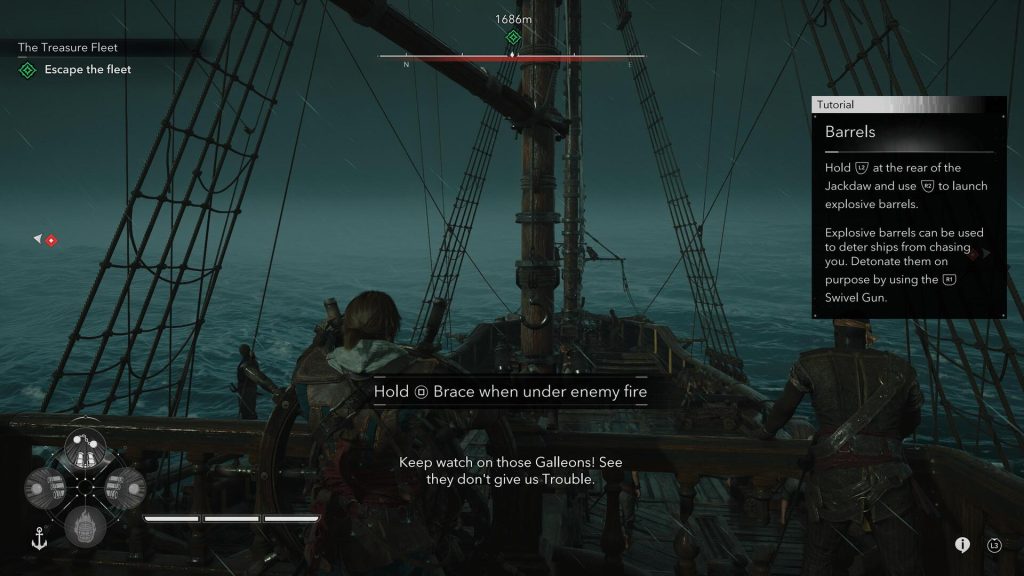
If there's one reason to play Black Flag in 2026, it's the naval combat. The Jackdaw isn't just a means of transportation between missions. It's practically the game's second protagonist.
Very few games manage to make you care about a vehicle this much. After a few hours you stop thinking of the Jackdaw as a ship and start thinking of it as your home, your greatest weapon, and your most valuable companion.
Every upgrade feels meaningful.
Stronger hull armor, heavier broadside cannons, chain shots that cripple enemy sails, heavy rounds that tear through wooden hulls, mortars capable of bombarding ships from long range, improved ram damage…
Almost every upgrade noticeably changes how your ship performs in battle. Naval combat isn't simply about firing cannons whenever the enemy appears.
You constantly need to manage positioning, wind direction, distance, and timing. Sometimes you'll try to cut across an enemy's path before unleashing a perfectly timed broadside. Other times you'll stay at range, raining mortar shells onto enemy ships before they even have a chance to respond.
When everything comes together, naval combat feels absolutely incredible. The Caribbean is filled with different enemy ships. Small Schooners are fast but fragile. Brigs offer a decent challenge. Frigates require proper preparation. Then there are the massive Man O’ War warships—floating fortresses capable of destroying even a fully upgraded Jackdaw if you make a few mistakes. Combat isn't limited to your cannons either. You can cripple enemy sails with chain shots, bombard ships from long distance using mortars, smash through hulls with heavy rounds, or simply ram your opponents before finishing them with a devastating broadside.
Once you've weakened an enemy ship enough, you have two choices. Sink it. Or board it.
The first few boarding sequences are incredibly cinematic. You leap onto the enemy vessel, eliminate the captain, cut down the enemy flag, defeat a set number of sailors, or destroy powder reserves before claiming your prize. Unfortunately, after several dozen hours the illusion begins to fade. Nearly every boarding action follows the exact same objectives, making them feel repetitive long before the game is over. Eventually, I stopped boarding altogether. It became faster—and honestly more satisfying—to simply send enemy ships straight to the bottom of the ocean. Even so… More than a decade later, I still don't think Ubisoft—or anyone else—has created naval combat that surpasses Black Flag. It's not just good. It's the reason this game is still remembered today.
Graphics
Visually, Assassin's Creed Black Flag Resynced looks fantastic.
I played the game on PlayStation 5 using Balance Mode, which targets 40 FPS on a 120 Hz display, and honestly, I think it's the best way to experience the game. You get visuals that are nearly identical to Quality Mode while enjoying noticeably smoother gameplay. Of course, it's not perfect. Facial animations occasionally feel stiff, and some character models clearly reveal the game's age. During close-up conversations, it's obvious that the original foundation is still more than a decade old.
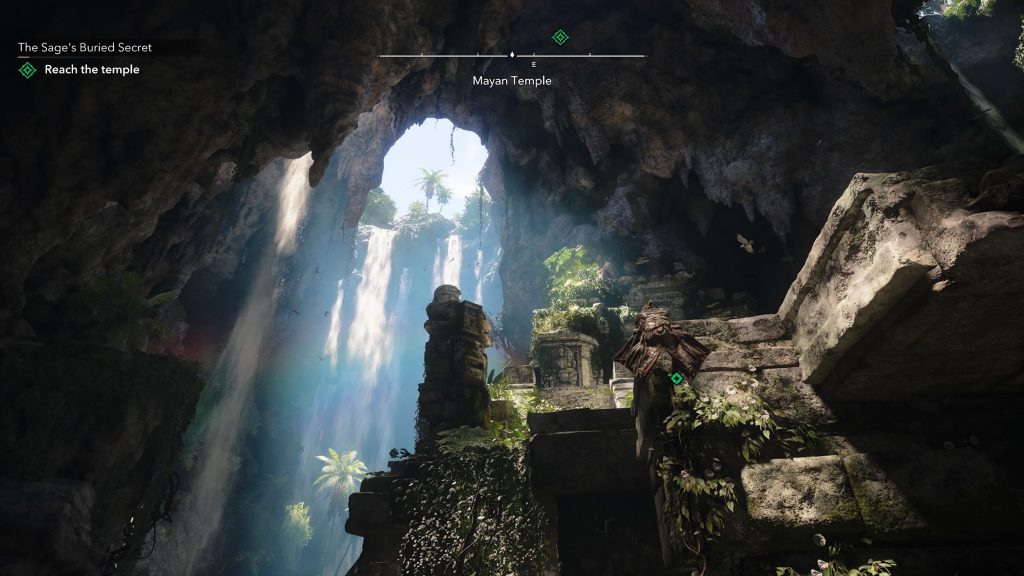
The moment you leave the cities, though… None of that really matters anymore. The Caribbean is absolutely gorgeous. Every island feels distinct. Dense jungles filter sunlight through thick vegetation, tiny fishing villages sit quietly along the coastline, hidden beaches invite exploration, and imposing Spanish forts dominate the horizon. Rather than feeling like a collection of disconnected locations, the world feels cohesive and believable. The vegetation deserves special praise. The jungles are lush, vibrant, and filled with countless shades of green. Sunlight breaks through the trees naturally, creating scenes that genuinely make you feel like you're exploring a tropical paradise. But the real star of the show is the ocean. Even today, very few games portray water this convincingly.
Its color constantly shifts depending on depth, weather conditions, and the time of day. One moment you're peacefully sailing across crystal-clear turquoise waters, and the next you're fighting towering black waves during a violent tropical storm. The ocean isn't simply beautiful. It feels alive. Massive waves constantly rock the Jackdaw, white foam trails behind your ship, rain crashes across the deck, and during storms the sea itself becomes as dangerous as any enemy fleet. Dynamic lighting elevates everything even further.
The same island looks completely different at noon than it does during sunset or in the middle of a thunderstorm. Warm orange skies gradually fade into deep purples as the sun disappears behind the horizon, while moonlight transforms the Caribbean into something entirely different after dark.
More than once I completely forgot about the mission I was supposed to be doing. I'd simply stop on the deck of the Jackdaw and spend a few minutes watching the ocean. Very few games make you do that.
Black Flag may not compete with modern AAA releases in terms of raw graphical fidelity, but its art direction, lighting, atmosphere, and environmental design allow it to outperform many technically superior games. That's far more impressive than simply pushing more polygons.
Sound & Music
The soundtrack is excellent, but what you'll remember most are the sea shanties. After a few hours, don't be surprised if you catch yourself humming them long after you've stopped playing. They're not just background music. They become part of the journey. Then combat begins. Cannons roar from every direction. Wood splinters. Masts collapse. Ships explode around you while smoke fills the air. More than once I genuinely felt like I was inside one of the Pirates of the Caribbean films, desperately steering through complete chaos while cannonballs flew overhead and enemy ships closed in from every direction. It's one of those rare moments where gameplay, visuals, and sound design work together perfectly. Voice acting is generally very strong throughout the campaign.
Unfortunately, the newly recorded dialogue added for Resynced stands out immediately—and not for the right reasons. The performances themselves are perfectly fine, but the writing simply lacks the quality and natural flow of the original script. On the other hand, the sound effects are phenomenal. The thunder of the cannons, the cracking of wooden hulls, collapsing masts, crashing waves, and the sheer power behind every broadside make each naval battle feel heavy, cinematic, and incredibly satisfying.
Performance
I played the game entirely on PlayStation 5 using Balance Mode, and overall the experience was very solid. Aside from a single crash, I never encountered anything serious enough to prevent progress or force me to reload an earlier save. That doesn't mean the game is bug-free. Far from it. There are still plenty of small glitches, awkward animations, questionable AI behavior, and the occasional physics hiccup. But honestly… It's Assassin's Creed. And it's Ubisoft. At this point, those things almost come with the territory.
Final Verdict for Black Flag
Assassin's Creed Black Flag Resynced is a game full of contradictions.
On one hand, you have outdated combat, stealth that's so overpowered it undermines the entire gameplay loop, awkward animations, questionable AI, Ubisoft's trademark bugs, and microtransactions that simply have no place in a full-priced release. If I judged the game purely by its flaws, the final score would almost certainly be lower. But games aren't math. You can't simply add up the positives, subtract the negatives, divide everything by two, and expect to arrive at the right score. Some games are technically brilliant but completely forgettable. Others are deeply flawed yet keep pulling you back. Black Flag belongs firmly in the second category.
Its naval combat remains among the best the industry has ever seen. Sailing across the Caribbean while your crew sings sea shanties still has no real competition. Exploration becomes genuinely rewarding once you remove the endless objective markers, and the fantasy of living as a pirate is so convincingly realized that I often found myself launching the game with no intention of progressing the story.
Sometimes I simply wanted to spend another hour at sea. Ironically, as someone who has never been particularly fond of classic Assassin's Creed gameplay, my favorite parts of Black Flag are precisely the ones that have the least to do with being an Assassin. The stealth never truly clicked. The sword combat became repetitive. Parkour was merely serviceable. Yet everything related to piracy kept me hooked until the credits rolled. That's probably the biggest compliment I can give the game. Despite every complaint I've mentioned throughout this review, Assassin's Creed Black Flag Resynced earns an 8/10 from me. Not because it's flawless. Far from it.
But because what it does well, it does so incredibly well that you'll often choose to forgive everything else. Once the Jackdaw raises its sails, your crew begins to sing, and the Caribbean stretches endlessly before you, it's remarkably easy to forget the awkward animations, repetitive combat, and occasional bugs. More than a decade later, Black Flag still isn't the best Assassin's Creed because of its Assassin gameplay. It's the best Assassin's Creed because it's still the best AAA pirate game ever made.
Ubisoft provided us with a PS5 review code for Assassin's Creed Black Flag Resynced.