
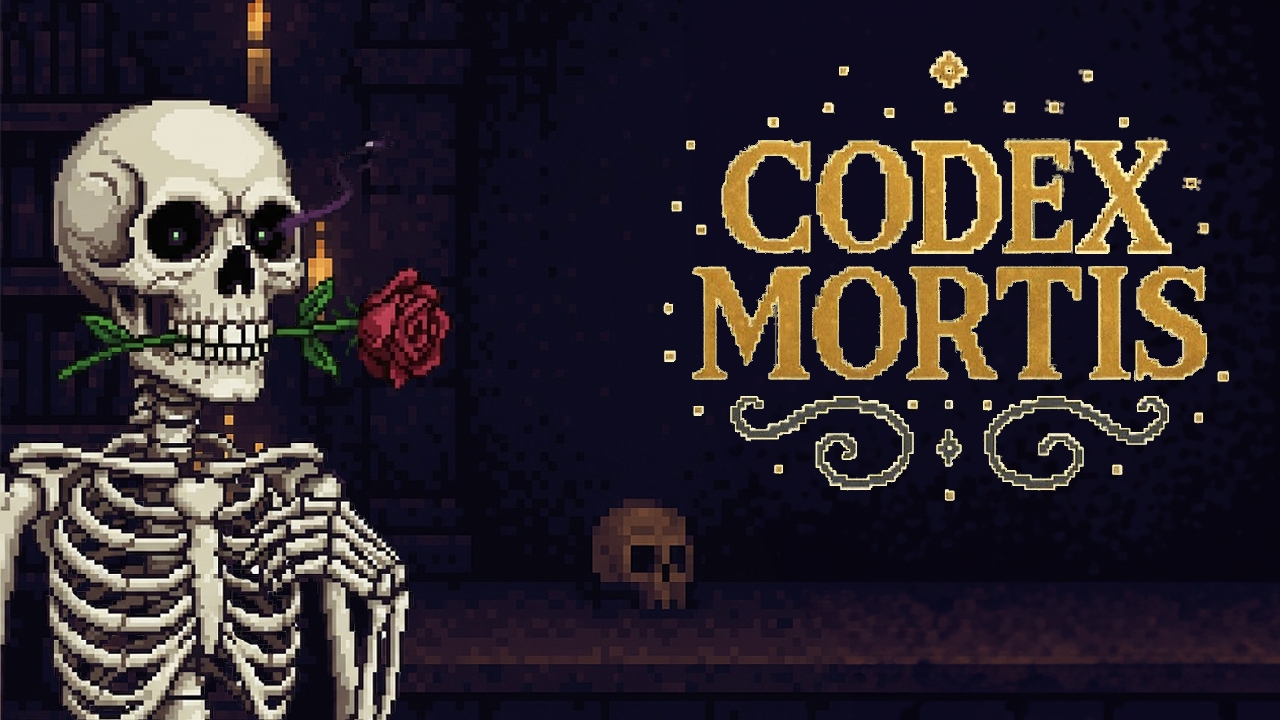
Codex Mortis: Codex Mortis is a survivors-like roguelite developed with extensive use of AI. We take a closer look at its gameplay, progression, build variety and whether this ambitious AI experiment actually results in a game worth playing. – NemanjaKocica
Some games attract attention because of what they do. Others become interesting because of how they were made. Codex Mortis belongs to the second category.
At first glance, it looks like another survivors-like roguelite: hordes of enemies, increasingly powerful abilities, endless upgrades and a screen that eventually becomes so crowded with effects that you can barely see what is happening. It is a familiar formula, and Codex Mortis does not exactly hide its influences.
But there is something very different about this particular game. The developer openly states that AI was used throughout the development process, including the code, artwork, writing, sound and music. That immediately turns Codex Mortis into something more than just another small roguelite.
It becomes an experiment.
And that raises a much more interesting question than whether AI was involved in making it: once you put all of that aside, is Codex Mortis actually a good game?
The answer is not quite as simple as yes or no.
Another Vampire Survivors clone?
At its core, Codex Mortis follows a formula that players of Vampire Survivors and similar games will immediately understand.
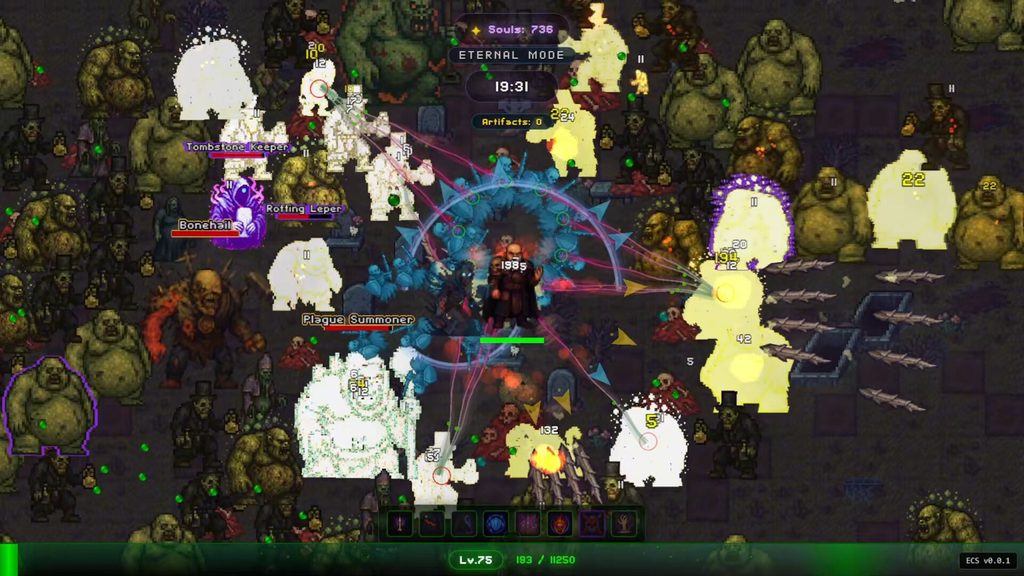
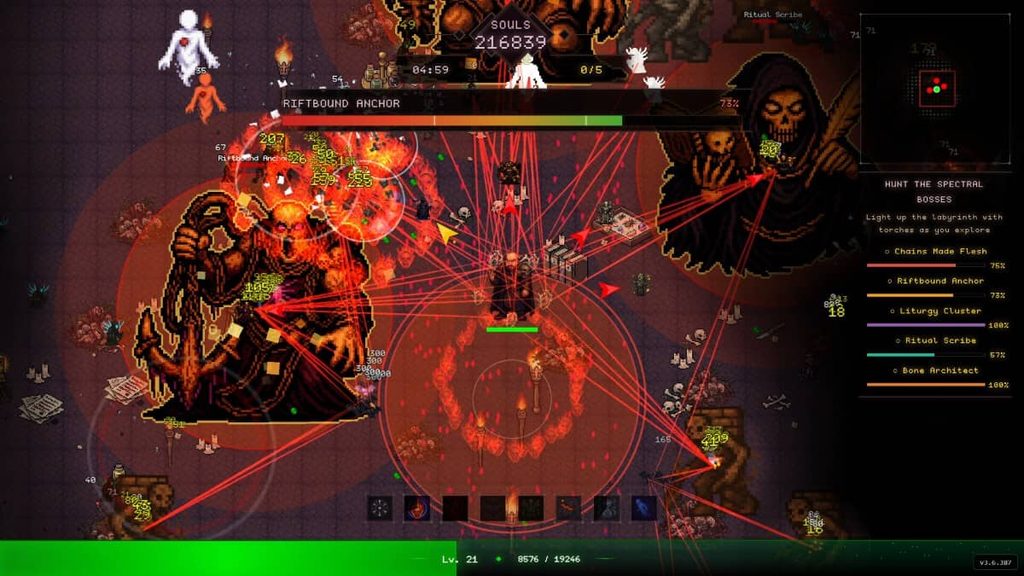
You enter a battlefield, enemies begin surrounding you from every direction, your abilities automatically take care of most of the attacking, and your main job is to survive, collect resources and decide how to develop your character. As the run progresses, your character becomes stronger, the enemies become more numerous and the screen slowly turns into complete chaos.
That part is nothing new.
What makes Codex Mortis more interesting is the number of systems built around that basic formula. The game gives you multiple schools of dark magic, a large selection of spells, different heroes, artifacts, mutations and various ways of combining abilities into powerful builds.
And this is where the game can genuinely become fun.
Finding a combination that works, watching your character grow increasingly ridiculous and then seeing an entire wave of enemies disappear in seconds is exactly the kind of simple satisfaction that makes this genre so addictive. The deckbuilding mechanics also add another layer to the usual survivors formula, giving you more control over what kind of build you want to create instead of simply picking whatever upgrade happens to appear on the screen.
There is a surprising amount to experiment with.
The problem is that not every system works equally well.
More systems don't always mean more depth
Codex Mortis has clearly evolved during development. The game went through major changes during Early Access, with its progression systems, presentation and deckbuilding mechanics receiving significant attention.
On paper, that sounds like exactly what you want from a game like this. More options, more build variety and more ways to approach each run should mean more depth.
In practice, some of these systems can make the experience more complicated than it needs to be.
The interface is not always as intuitive as it should be, and navigating some of the menus can take a while to understand. This becomes particularly noticeable when you start dealing with the game's different progression systems and all the options available to you.
A good roguelite should make you curious about what you can build next. Codex Mortis sometimes makes you stop and wonder where exactly you are supposed to find the thing you just unlocked.
That is not enough to ruin the experience, but it does make the game feel less polished than it could be.
When the fun starts becoming repetitive
This is probably the biggest problem Codex Mortis has to overcome.
There is a lot of content here. The full version offers a substantial number of levels, heroes, spells and different magical combinations, along with support for co-op gameplay. On paper, that sounds like more than enough to keep you busy for a long time.
But content and variety are not always the same thing.
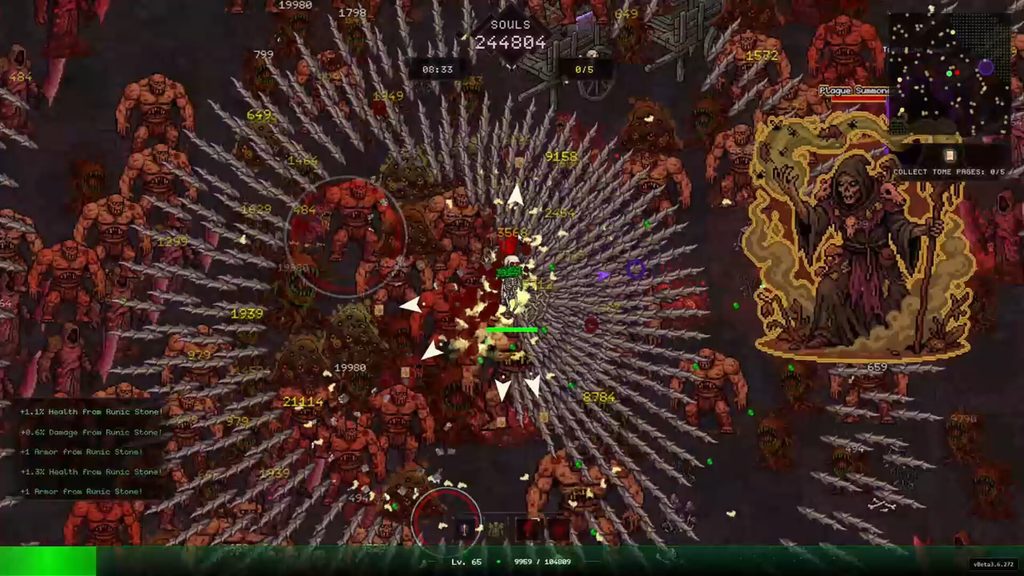
After spending enough time with the game, the basic structure of the experience starts becoming predictable. You enter a level, survive waves of enemies, improve your build and work toward unlocking more content. Then you do it again.
And again.
The build system helps by giving you different combinations to experiment with, but it cannot completely hide the repetitive nature of the core gameplay loop. Some missions can also feel like they are there primarily to extend the experience rather than introduce a genuinely new idea.
Progression can have a similar problem. Unlocking new content gives you a reason to keep playing, but at times the amount of grinding required starts feeling more like a way to stretch the game's lifespan than a meaningful part of the progression.
This is a difficult balance for the genre in general, and Codex Mortis does not always get it right.
The AI elephant in the room
Of course, we have to talk about the AI.
There is no point pretending it is just another technical detail. The use of AI is one of the defining characteristics of Codex Mortis, and the developer has been unusually open about how deeply it was integrated into the game's development.
According to the developer, AI was used for practically every major component of the project: programming, artwork, music, sound and writing.
That is impressive from a technical perspective.
It is also where the conversation becomes much more complicated.
Because Codex Mortis is not simply a game where AI helped with a few textures or generated some concept art. It is an attempt to use AI as a fundamental part of the entire development pipeline.
That makes the game fascinating even before you start playing it.
But it also creates a problem: the technology itself does not automatically produce good game design.
Where the AI approach starts to show
The interesting thing about Codex Mortis is that you do not necessarily look at it and immediately think, “This was made by AI.”
The visual style is functional and, in many situations, works surprisingly well for the genre. When the screen is filled with dozens or even hundreds of enemies and effects, a simpler visual identity can actually be beneficial because readability becomes extremely important.
The problem is less about whether individual assets look convincing and more about whether everything feels like it belongs to the same creative vision.
At times, Codex Mortis feels like a collection of systems and ideas that work individually but do not always come together with a particularly strong identity. Some elements feel generic, some mechanics feel familiar and the game occasionally gives the impression that it knows what a modern roguelite is supposed to contain without always knowing what would make it truly memorable.
And that is where the AI discussion becomes relevant.
The biggest weakness of AI-generated content is not necessarily that it looks bad. The bigger issue is whether there is a clear creative voice behind it.
Great games are not simply collections of functional mechanics, impressive visuals and lots of content. They have personality. They have a sense of direction. They know what they want to be.
Codex Mortis gets some of that right, but it does not consistently reach the level of a game with a particularly strong authorial identity.
So, does the AI actually matter?
This is where I think Codex Mortis becomes more interesting than the usual “AI-made game” debate.
I do not think using AI should automatically cost a game points.
What matters is what the technology contributes to the final product.
If AI allows a small developer to create systems, visuals, music and content that would otherwise be completely out of reach, that is genuinely interesting. Codex Mortis demonstrates that AI can help a very small development effort produce something far more substantial than a simple prototype.
But there is an important distinction between making a game and making a memorable game.
Codex Mortis proves the first point much more convincingly than the second.
The developer's own development process also illustrates why the idea that AI can simply generate a complete game from a single prompt is misleading. Getting from an initial prototype to a functioning full release still required iteration, rewriting systems, solving technical problems and making countless adjustments.
AI can generate a lot.
It does not automatically know what should stay, what should be removed and what needs to be completely redesigned.
That still requires human judgement.
A surprisingly functional experiment
And despite all those criticisms, dismissing Codex Mortis as nothing more than “AI slop” would also be unfair.
There is a real game here.
The core gameplay works. The different schools of magic provide room for experimentation. The combination of spells, heroes and mutations can produce genuinely enjoyable builds, and the progression gives you a reason to keep coming back.
The co-op support is another welcome addition, especially considering the chaotic nature of the gameplay. Watching several players unleash increasingly absurd magical abilities at the same time fits the game's concept surprisingly well.
This is not a broken experiment that exists only to prove a technological point.
It is an actual game that can be fun to play.
And that might be the most important thing to acknowledge.
The Verdict
Codex Mortis is more interesting than its AI gimmick suggests, but it is not good enough to escape criticism simply because of how ambitious its development approach is.
As a survivors-like roguelite, it has a solid foundation. There are enough spells, heroes, combinations and progression systems to keep you experimenting, and when everything comes together, the game delivers exactly the kind of chaotic power fantasy that makes this genre work.
At the same time, repetition eventually starts to take its toll. Some progression systems feel more grind-heavy than rewarding, the interface could be more intuitive and the game does not always have the strong creative identity that would separate it from the many other titles built around this formula.
Then there is the AI question.
Codex Mortis is not proof that AI can replace game developers. It is, however, a fascinating demonstration of how far a single developer can push AI as a development tool. The result is a complete and playable game rather than a simple technical showcase.
But that is also where the experiment becomes most revealing.
AI can help make a game. It cannot automatically give that game a soul.
Codex Mortis proves that the technology is capable of helping create something playable and surprisingly ambitious. What it does not yet prove is that AI alone can consistently deliver the creativity, personality and strong sense of identity that make great games stand out.
For now, Codex Mortis feels less like the future of game development and more like a glimpse of one possible future.
And honestly, that makes it worth playing.