
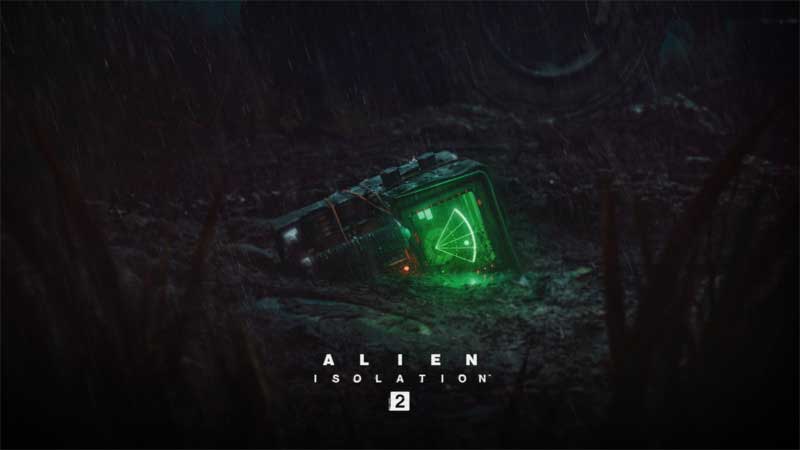
There are some games where, after just a few minutes, you immediately know what kind of experience you're in for. Then there is Alien: Isolation 2, a game that reminds you why sometimes the best part of a horror game is simply not knowing what is waiting around the next corner.
After years of waiting for a sequel, getting the chance to see Alien: Isolation 2 at Gamescom 2026 was one of the presentations we were particularly looking forward to. The original Alien: Isolation managed to do something that many games featuring the Xenomorph failed to achieve – it didn't turn the creature into a regular enemy that you were supposed to defeat, but into something that constantly existed somewhere in the back of your mind. You were never completely sure where it was, when it would appear, or whether the next sound you heard would force you to hide.
That feeling is what made Isolation so special, so the first question we had was simple: how do you make a sequel without ruining what already worked?
From what we saw, Creative Assembly doesn't seem interested in simply making a bigger version of the original.
You're No Longer Trapped Only Inside a Space Station
One of the biggest changes we were able to see is the space in which the story takes place. The original Alien: Isolation built almost all of its horror around Sevastopol. The corridors, ventilation shafts, dark rooms, and industrial complexes created the feeling that you were constantly moving through a gigantic trap with no way out.
Alien: Isolation 2 decides to expand on that concept.
During the presentation, we were introduced to a new protagonist, Blake, and saw environments that give the sequel much more room to play with atmosphere. What is particularly interesting is the combination of more open outdoor locations with claustrophobic interiors. On paper, you might expect a larger space to mean greater safety, but Alien: Isolation 2 is trying to turn that idea on its head.
Because having more space doesn't necessarily mean having somewhere to escape to.
In fact, when you have more open space around you, you lose some of the security that walls and doors provide. You can see much farther, but at the same time you have much less control over what is happening around you. If you hear something in the distance, you can't simply assume that the danger is waiting behind the next door.
That might be one of the ways the sequel is trying to establish its own identity instead of simply repeating the original.
The Xenomorph Is Still the Biggest Problem
Of course, there is no Alien: Isolation without the Xenomorph.
The biggest strength of the original was that the game never completely convinced you that you were in control of the situation. The Xenomorph wasn't an enemy waiting at a predetermined location for you to find it. Its presence was something you could feel even when you couldn't see it.
From what we saw, the sequel wants to keep exactly that principle.
Creative Assembly is once again putting a strong emphasis on the Xenomorph's dynamic behavior, and the Gamescom presentation gave us a glimpse of an enemy that still feels unpredictable enough to make you think several steps ahead. The problem isn't simply “how do I defeat this enemy?” but what if it has already found me and I just don't know it yet?
That distinction is extremely important for this kind of horror.
In most games, an enemy is an obstacle between you and the next part of the level. In Alien: Isolation, the enemy itself is the reason you want the level to end as quickly as possible. Every walk through a corridor becomes a potential problem. Every door you have to open could be the last thing you do before hearing the sound you desperately didn't want to hear.
And that's where Alien: Isolation 2 has its biggest responsibility. The Xenomorph needs to be terrifying not because it has more health or stronger attacks, but because you can't easily predict what it will do.
More Space, but Less Sense of Safety
This is probably the most interesting part of what we saw.
When a sequel gets larger and more open environments, there is always a risk of losing what made the original such an effective horror game. If the player can freely run around, easily find an escape route, and always knows where they are, the Xenomorph stops feeling like a real threat.
That's why it was interesting to see how the sequel is trying to create a different form of vulnerability.
Sometimes the fear came from having only one dark corridor in front of you. Now it could come from having several possible paths while knowing that none of them are completely safe.
You might try to stay outside and avoid enclosed spaces, but that could make you much easier to spot. You might look for shelter indoors, only to find yourself in a place where escaping is much more difficult.
In other words, the game is trying to make you make decisions instead of simply following a predetermined path.
The Atmosphere Still Comes From 1979
The visual identity is another aspect that left us satisfied after the presentation.
One of the biggest risks for the sequel would have been turning Alien into another generic modern sci-fi horror game. Instead, Alien: Isolation 2 continues to draw heavily from the visual language of the original 1979 film.
Industrial interiors, analogue technology, terminals, cables, metal surfaces, and the way lighting is used to hide more than it reveals once again create that distinctive Alien feeling. Everything looks modern enough for a contemporary game, but also old-fashioned enough to make you feel like you've stepped into the same cinematic universe.
And honestly, that's exactly what we wanted to see.
Alien has never been just a story about an alien creature. Its atmosphere comes from a combination of technology, industrial design, isolation, and the feeling that humans have been sent into an environment that was never really made for them.
If the sequel manages to preserve that feeling, it will have already done a large part of the job.
We Don't Need More Action, We Need More Fear
Perhaps the biggest risk for Alien: Isolation 2 is the expectation that a sequel has to be bigger than the original.
A bigger world, more locations, more mechanics, and more enemies might sound like the logical next step, but with a horror game, more isn't always better. The more options you give the player, the harder it becomes to maintain the feeling of helplessness that horror needs to work.
That's why I was glad the presentation didn't give the impression that Creative Assembly wants to turn Alien: Isolation into an action game. The idea seems to be less about simply giving us more of everything and more about expanding the existing formula in ways that can create new situations.
If we remember the original for making us afraid to walk down a single corridor, the sequel might make us wonder whether it is even a good idea to leave the building.
And that's a pretty good starting point.
The Xenomorph Is Back
After the Alien: Isolation 2 presentation at Gamescom, I was left with that strange feeling the original managed to create – I'm excited about the game, but at the same time I'm not entirely sure I actually want to spend hours running away from the Xenomorph again.
The sequel still has plenty to prove before release, especially when it comes to balancing larger environments with the claustrophobic atmosphere that made the original so special. But what we saw suggests that Creative Assembly understands why the first game worked.
We don't need a Xenomorph that is simply faster, stronger, or more common.
We need a Xenomorph that makes us afraid of our own footsteps again.
And after Gamescom, we can definitely say that the Xenomorph still knows how to make us nervous.
And honestly, we can't wait to be terrified all over again.