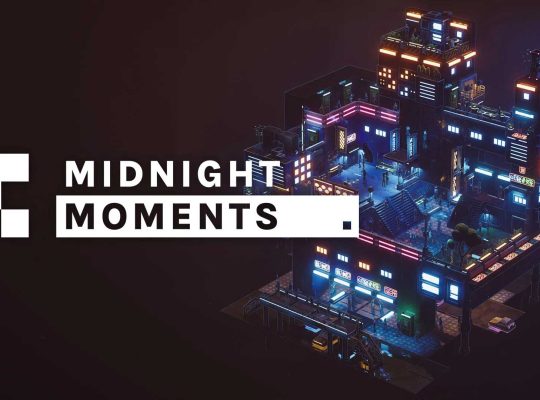

Midnight Moments: Midnight Moments never tries to be a big or complex game. Instead, it offers a small creative space where you can build your own cyberpunk scenes and simply enjoy the atmosphere. The rain, neon lights and small details work together beautifully, although the limited space and selection of elements can eventually become noticeable. If you enjoy games like Townscaper and Dystopika, there is plenty to like here, as long as you are looking for relaxation rather than depth or traditional progression. – NikolaOtasevic
Sometimes all it takes is a single small street to give you the feeling that an entire city exists somewhere behind it. One building, a few windows glowing in the night, a neon sign, a person standing on a corner and rain running down the facades can be enough to make you start wondering who lives there and what is happening behind those closed doors.
That is exactly the idea behind Midnight Moments. Happy Volcano gives you a small piece of a cyberpunk city and lets you arrange it however you want, without objectives, deadlines or any kind of pressure. The only question that remains is how long you can enjoy the process of creating.
And that is practically it.
There are no objectives you have to complete, no timer forcing you to be efficient, no resources you need to manage, and no punishment if you place something completely wrong. Midnight Moments simply lets you build. You can create a few buildings, connect them with narrow passages, add neon advertisements, antennas, plants, citizens and various little details, and then sit back and watch the rain slide across everything you have created.
At first, it might sound like a very simple idea, but that simplicity is where much of the game's charm comes from.
Happy Volcano has created a cyberpunk diorama builder in the spirit of games such as Townscaper and Dystopika, but here the atmosphere is much more important than the actual building. You are not trying to create the biggest or most efficient city. There is no “best” way to build it. Instead, the goal is to turn a small space into a scene that looks good to you. And when the game gets that right, it is surprisingly easy to spend quite a lot of time simply looking at your own little street.
A City Built Around Atmosphere
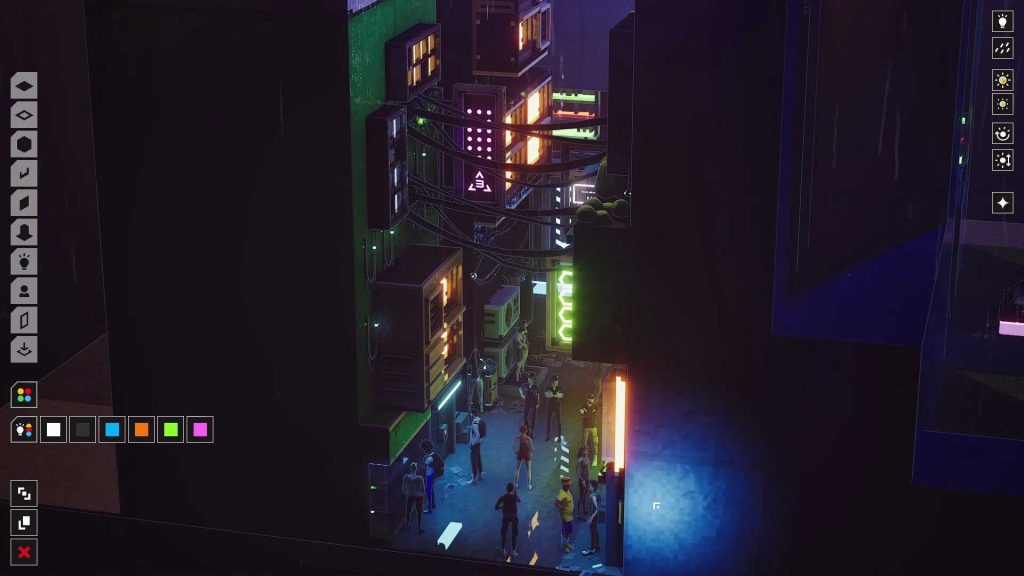
The biggest strength of Midnight Moments, without a doubt, is its atmosphere. It is the kind of game that can catch you off guard when you suddenly realize that you have spent several minutes doing nothing in particular, simply moving the camera around and watching how the world looks.
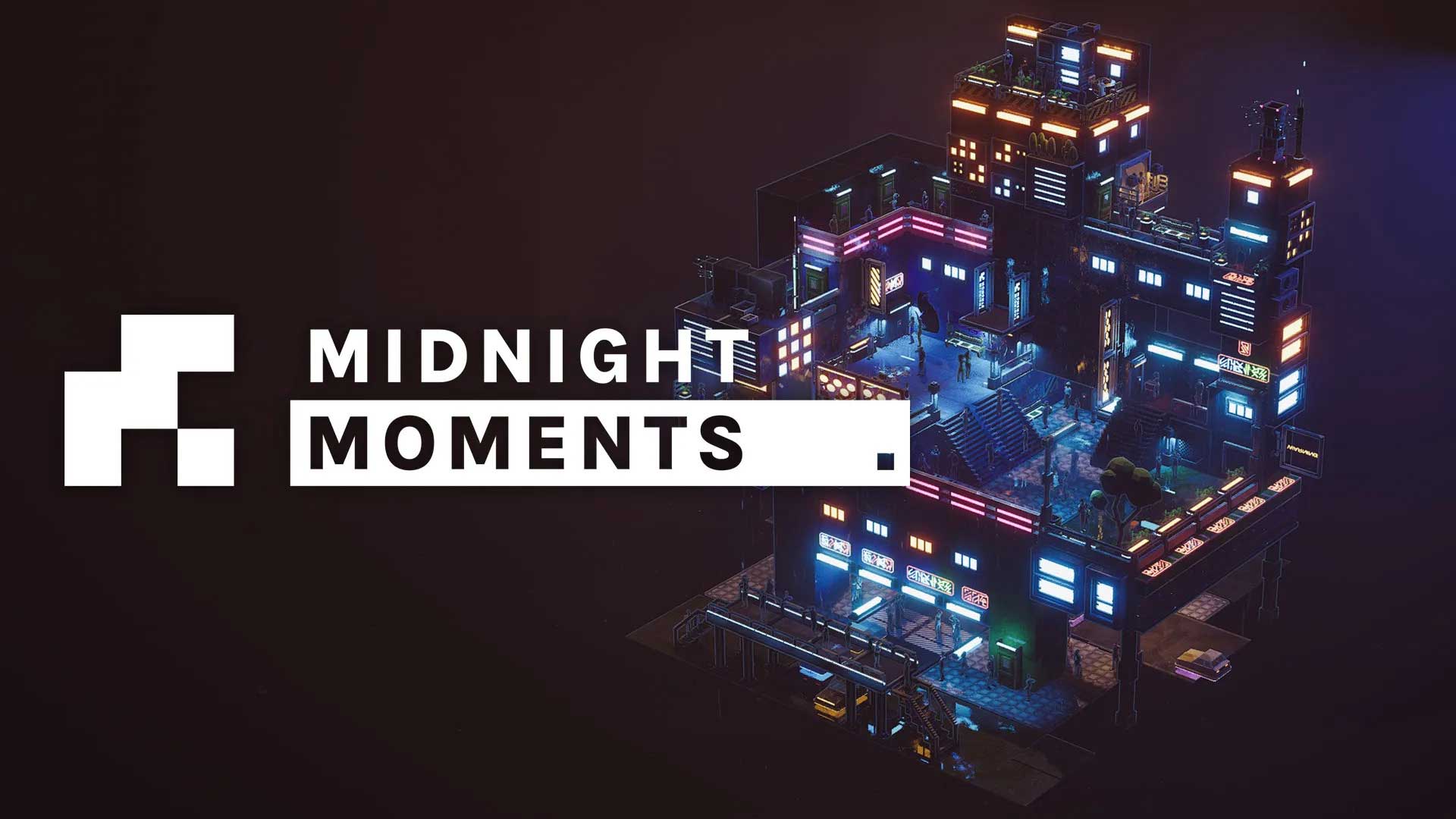
Rain is not just a visual effect here. It is practically part of the game's identity. Wet surfaces catch the glow of neon lights, building windows bring warmth to the dark streets, advertisements illuminate the surroundings, and the combination of cool and warm tones gives the entire city that recognizable cyberpunk feeling. The game doesn't need to explain where you are. A few buildings, some neon and an endless downpour are enough.
I particularly like the amount of control you have over how your scene looks. Changing the intensity of the rain, the lighting or the time of day can completely transform the atmosphere of the same location. At one moment, a small alley can feel like a quiet part of the city where people are simply making their way home, while a few changes later it can take on a much darker, almost noir-like appearance. The game manages to get more out of its relatively limited space than you might initially expect.
A single neon sign placed in the right spot can make a bigger difference than an entire new building.
That is where you can see that Midnight Moments is less interested in quantity and more interested in detail. An antenna on a rooftop, a bench beside the street, a vending machine, a few plants, a holographic detail or a citizen standing in just the right place can be enough to suddenly make the space feel like a real part of a city.
Of course, this isn't a city in the traditional sense. It is more like a small scene pulled out of a much larger world. And that is exactly why it works.
You Are Not Building a City, You Are Creating a Scene
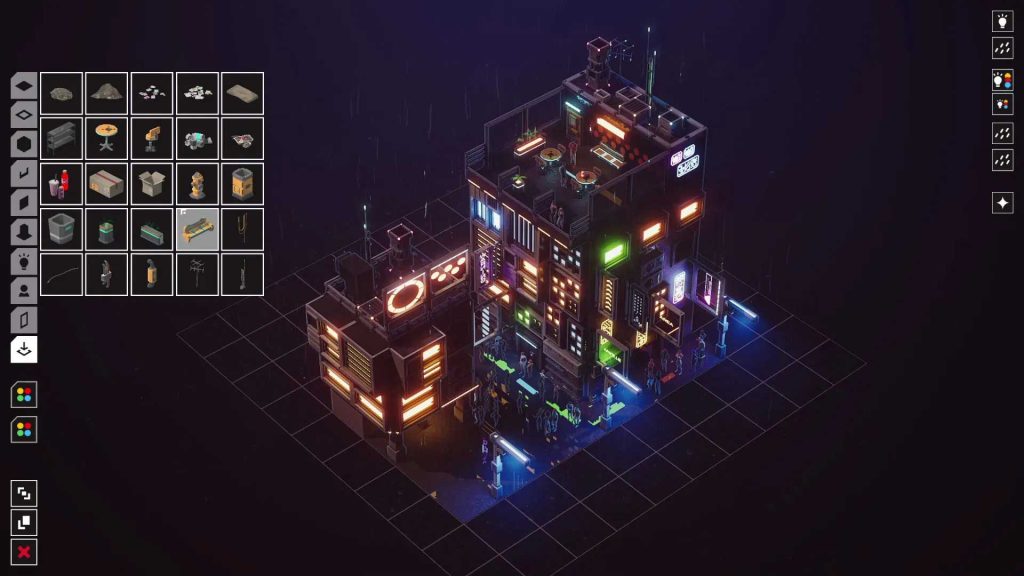
The limited space is something that can very easily be seen as a drawback at first. The grid is small, the number of elements is not endless, and there is no way to build a huge cyberpunk metropolis. However, the more time you spend with the game, the clearer it becomes that this was probably the intention. Midnight Moments doesn't want to turn you into the builder of a massive city. It puts you more in the role of a set designer.
Instead of thinking about where to put the next fifty buildings, you start thinking about what this one small space is missing. Maybe it needs another source of light. Maybe a passage between two buildings would look better. Maybe adding a few citizens would completely change the feeling of the scene.
You can create a small nightclub entrance, a rooftop garden, a residential block, a narrow street filled with shops, or simply an ordinary corner of a city that looks as if it has a much bigger story hiding behind it.
And that leads to something quite interesting: the game leaves plenty of room for you to imagine what is actually happening in these scenes. The character standing outside a shop doesn't have a story. The building has no history. There is no quest explaining what happened there. But once you put all the elements together, your brain starts filling in the gaps on its own. Suddenly, you are no longer looking at a few buildings.
You are looking at a place.
A Game That Asks Nothing From You
For some players, the complete lack of objectives might be the biggest problem, but for me it mostly made sense here. Midnight Moments doesn't try to convince you that there is something you have to finish. You start the game, build something and turn it off when you've had enough. That is the entire philosophy.
The tools are simple enough that you don't need much time to learn them. There are no complicated systems you have to understand before you can start creating something that looks good. After only a short time, you can already produce something that looks perfectly decent, and the more time you spend on the details, the more interesting the scene can become.
That is also why I can easily imagine many people using the game almost as a digital space for relaxation. After a long day, you can start it up, put some music or a podcast on in the background and spend half an hour arranging a small street. If you like what you've created, you're done. If you don't, move a few things around and try again.
At a time when so many games almost obsessively try to tell you what you should be doing and why you need to keep playing, this approach actually feels quite refreshing.
But That Is Also Where the Problems Begin
Of course, that freedom comes with a price.
After creating several scenes, you begin to notice the limits of what Midnight Moments has to offer. Once the initial excitement of the rain, neon and first beautiful dioramas wears off, it becomes obvious that there simply aren't enough elements to keep surprising you for a long time.
You can create plenty of different combinations, but eventually you start recognizing the same buildings, the same objects and similar details. New scenes can look different, but there comes a point when you realize that you are still constantly working within the same small part of the city.
That doesn't mean the game is bad. It simply means that, by its nature, most players will probably reach the limits of its content relatively quickly.
This becomes even more noticeable when you want to customize certain elements in greater detail. Sometimes you wish you had more control over an object, a different size or more options for specific details, but the game stops you there. The camera is also not particularly intuitive at first, and it takes a little time to get used to how it works.
In another game, that might not be particularly important. Here, it is, because creative freedom is practically the entire game. When a game tells you “build whatever you want,” it is natural to want as many tools as possible to make that happen.
How Long Can You Stay?
That is probably the most important question to ask when it comes to Midnight Moments. The answer will depend heavily on what you expect from the game.
If you enjoy creating a beautiful scene, taking a screenshot, changing the lighting and then moving on to something else, Midnight Moments can be a very pleasant experience that you occasionally return to.
If, however, you expect progression, unlockable content, rewards or some kind of system that gives you a reason to continue playing for several more hours, you will very quickly run out of a concrete reason to do so. The game doesn't reward you for creating something beautiful. Its reward system is much simpler — if you like what you've created, that is enough. I personally like that approach, but I can't ignore the fact that some players may find that Midnight Moments ends up feeling shorter than they would have wanted.
A Small Game That Knows What It Wants to Be
Still, what I perhaps appreciated most about Midnight Moments is that the game never tries to be something it isn't.
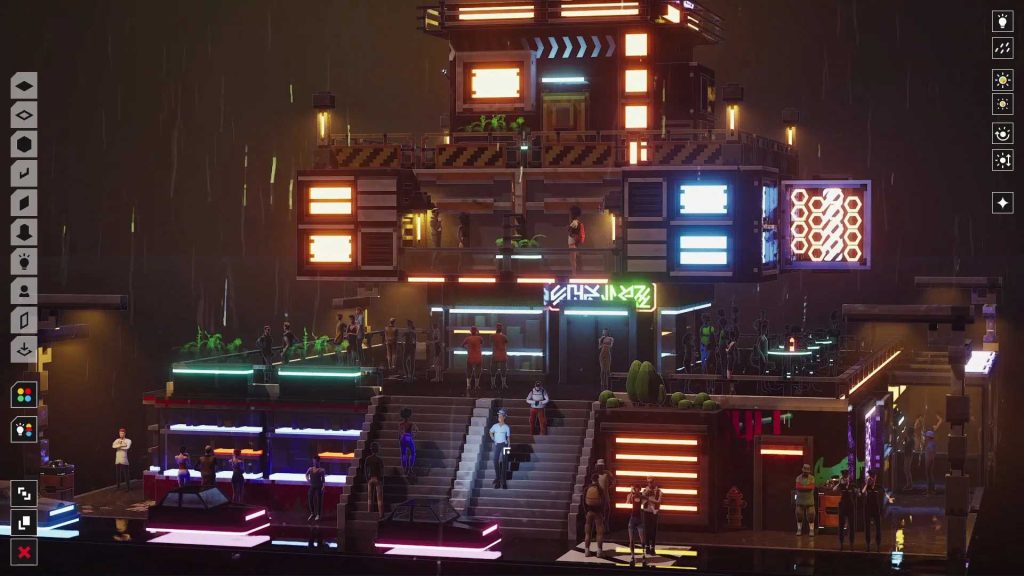
It doesn't try to turn its small world into a massive sandbox. It doesn't add unnecessary systems simply so it can say that they are there. It doesn't try to keep you playing through artificial progression. It wants to give you a small space and an atmosphere. And it succeeds at that fairly well.
Once you finish a scene, you can simply leave the camera there. The rain continues to fall, lights reflect off the streets, small characters move through the space you created, and for a moment everything looks like a shot from a cyberpunk movie. That is perhaps when Midnight Moments works best.
Not while you are building, but after you've finished and are simply looking at what you created.
Conclusion
Midnight Moments is not a game that will keep you occupied for dozens of hours, and it certainly isn't aimed at players looking for a deep gameplay loop, serious progression or complex building systems. Its ambition is much smaller, but because of that, it is also much clearer. It wants to give you a small piece of cyberpunk city and enough freedom to turn it into something that feels like your own. Its atmosphere is excellent, the combination of rain, neon and small details works very well, and the simplicity of its tools means you can start creating something without having to spend hours learning the systems. On the other hand, the limited number of elements and the small space mean that you will relatively quickly start noticing everything the game doesn't have.
But perhaps the fairest way to look at Midnight Moments is exactly the way it wants you to look at it. Not as a game you have to play every day. Not as something you have to finish. Instead, think of it as a small digital space you return to when you want a little peace.
Build a street. Add some neon. Place a few people. Let the rain fall.
And then just watch.
Midnight Moments may not have a huge amount to offer, but what it does offer is built around a clear idea and enough charm to make those few hours spent in its little cyberpunk world a pleasant experience.
Score: 7/10