
After having the opportunity at Gamescom 2026 to see four projects supported through the Japan Creator Support Fund, Top Game Creators Academy (TGCA) and CESA, we decided to dedicate a separate article to each of them. In our previous article, we took a closer look at how this support system works and why it is important for smaller creators to receive not only help with developing their ideas, but also opportunities to present their projects outside Japan.
Read our article about Japan’s game creator support initiative
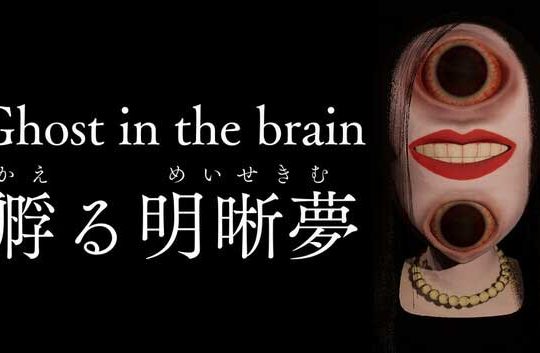
One of the games that particularly caught our attention was Ghost in the brain, a psychological horror title from simizu games that plays with one of the most unreliable things we have – our own memories.
We play as Yosihide Mizuno, a painter who uses the body of his deceased younger sister Misao as a subject for his paintings. As his solo exhibition approaches, Yosihide begins to question his own memories and whether the events he remembers actually happened the way he believes they did. In an attempt to find answers, he agrees to undergo an unusual form of hypnotherapy that is supposed to allow him to recover his memories with greater clarity.
Of course, it quickly becomes clear that this will not be a simple journey into the past.

When Memories Become a Nightmare
The world that emerges inside Yosihide's reconstructed memories becomes increasingly strange as we progress. Huge creatures with eyes, the ghost of a drowned girl, a bizarre butterfly with a girl's head and even a flying arowana begin to appear, creating an atmosphere that feels more like the worst possible nightmare than ordinary memories.
What I find particularly interesting here is that the horror does not rely entirely on the classic jump-scare approach. Of course, there are disturbing creatures and situations where you will want to get away as quickly as possible, but the bigger problem is the feeling that you cannot completely trust what you are seeing.
When the entire adventure takes place inside someone's memories, every new piece of information automatically comes with a certain degree of doubt. What we are seeing might represent an actual event, it might be part of a distorted memory, or perhaps our protagonist is no longer capable of telling the difference between the two.
That is exactly what creates a very specific kind of unease. You are not simply afraid of what is in front of you; you begin to wonder whether what you are seeing is even real.
How Much Can We Trust Our Own Memories?
Ghost in the brain combines exploration, puzzle solving and survival encounters with supernatural creatures, but the theme of memory is what I find most interesting about the entire game.
If the story is gradually reconstructed through Yosihide's memories, then the player is not simply someone trying to find the next clue. At the same time, you have to question whether the clue you have just discovered can actually be trusted.
This creates an interesting situation where the story itself becomes part of the mystery. You are not simply trying to discover what happened, but also trying to understand how the protagonist remembers what happened.
I find this approach to psychological horror much more interesting than the classic model where there is a clearly defined threat that you simply need to avoid. Here, reality itself becomes the problem. When memories can be distorted, every new piece of information can create another question instead of providing an answer.

Puzzles, Exploration and Survival
Ghost in the brain does not try to reduce everything to atmosphere and story. The gameplay combines exploration, puzzle solving and surviving encounters with supernatural creatures.
I particularly like how naturally these elements fit into the game's central idea. As you explore reconstructed memories, discover fragments and try to connect everything you have seen, you also have to pay attention to the creatures inhabiting this strange world.
The game therefore creates a balance between curiosity and caution. You want to explore as much as possible and discover what is really happening, but there is also a reason to think carefully about how far you want to go.
This is also where the game's Keyhole Peeking system comes into play, forming part of the way the game encourages observation and exploration. Rather than giving you every piece of information directly, Ghost in the brain encourages you to carefully observe what is happening around you.
A World That Feels Deliberately Wrong
The visual style further strengthens the feeling of unease. Ghost in the brain does not try to make every scene realistic. Quite the opposite – some things look so strange that they become even more unsettling because of it.
This works particularly well when ordinary elements are placed in completely wrong contexts. Something that would normally look harmless can suddenly become disturbing when it appears inside a distorted memory.
The grotesque creatures and unusual scenes therefore serve a purpose beyond simply filling the world with enemies. They contribute to the feeling that we are exploring a mind that is no longer completely reliable and whose rules we cannot always understand.
A Horror That Doesn't Have to Chase You to Be Uncomfortable
The most interesting thing about Ghost in the brain is that the biggest source of fear may not actually be the monsters themselves, but the fact that we cannot completely trust the world we are exploring.
The protagonist is trying to find the truth through his own memories, but the deeper he goes, the harder it becomes to separate what actually happened from what his mind may have changed. This gives the game an opportunity to build its horror gradually through atmosphere, exploration and the questions that appear as the player tries to understand the story.
That is something I particularly liked about the concept. A monster does not need to be constantly standing in front of you for the game to make you uncomfortable. Sometimes it is enough to make you wonder whether what you are looking at is actually real.
A Very Interesting Project So Far
Ghost in the brain is still in development and currently does not have a final release date, so we will have to wait for the complete game before making a final judgment. The project is currently listed on Steam as a TGCA Selected Creator title, with CESA and the Agency for Cultural Affairs also associated with the program.
Still, what we had the opportunity to see at Gamescom was enough to show us that simizu games has a very clear idea of the kind of horror it wants to create.
Ghost in the brain is not simply trying to make you afraid of what is hiding in the darkness. Instead, it does something much more interesting by making you question whether you can trust your own memories, your own eyes and what the game is showing you.
And when a horror game manages to make you question even what you see right in front of you, that is already a very strong foundation for a psychological horror experience.
The game was played on: PC.